Showing posts sorted by relevance for query monarch. Sort by date Show all posts

Sunday, July 31, 2011

Monarch and Viceroy Butterflies

 Viceroy butterflies taste good, to those that like to eat butterflies.  But they don't want to get eaten.  And time has favored those that look more like a Monarch butterfly to not get eaten as often, so today we have a Viceroy butterfly that looks more and more like a Monarch butterfly with each passing generation.  Evolution at work.

I took these photos today in Springbrook's south prairie about 100 feet apart from each other.
This Monarch tastes terrible because the caterpillar below eats milkweed leaves that are very bitter.  After trying to eat one most predators will not try to eat a second Monarch, and most are fooled into thinking the Viceroy is also a Monarch.  Mimicry works!

The Viceroy's hind wing stripe is not present on the Monarch as you can see in this picture.  This is a male Monarch, identified by the black "scent pouches" along the inside vein on the hind wing.  But the two butterflies do look a lot alike. 
The Monarch caterpillar chews a notch in the middle vein on the underside of a milkweed leaf so the leaf will fold down.  Then the caterpillar hangs from the underside and eats the leaf in relative hiding.  But the bright colors on the caterpillar tell all predators that it tastes bad and will make them sick if they eat it. 

This caterpillar was on the east end of Springbrook's south prairie this morning, shaking the raindrops off from last night's storms and eating as fast as it could.

Thursday, July 13, 2017

Monarch Caterpillar Fly Parasite

 Monarch Butterflies are one of the best known butterflies in Minnesota.  Many people grow milkweed and protect milkweed plants, on which the Monarch caterpillars feed.

But in nature there are many battles every species needs to constantly fight to have its population stay healthy and survive to reproduce the next generation.

For the Monarch a parasitic tachinid fly is one of the battles it must face.
 This particular tachinid fly lays its eggs directly onto the skin of the Monarch caterpillar.  It will lay up to eight or more eggs on one caterpillar.


The eggs hatch and burrow into the insides of the  caterpillar, feeding on non-vital tissue, so the caterpillar can stay healthy enough to keep eating, providing more food for these parasites.


The fly larvae, which are small white maggots, continue to eat inside the caterpillar until they are ready to pupate, the stage of metamorphosis in which they will prepare to turn into adult flies.  To do this the maggots have to leave the caterpillar and drop to the ground.

 The process of the fly larvae leaving to pupate in the dirt on the ground often happens shortly after the caterpillar has changed into a chrysalis itself, the Monarch's pupa stage.


After the fly maggots eat an exit hole in the caterpillar or chrysalis, and drop to the ground, the Monarch caterpillar or chrysalis always dies.  Its vital organs finally having been eaten by the maggots before they left.


Below are eight pupae of the parasitic tachinid fly shortly after they emerged from a Monarch chrysalis 11 days ago.
 The white maggots turned into these brown pupae very quickly after they emerged from the chrysalis.


They stayed like this for ten days, and began to emerge as adult flies yesterday.
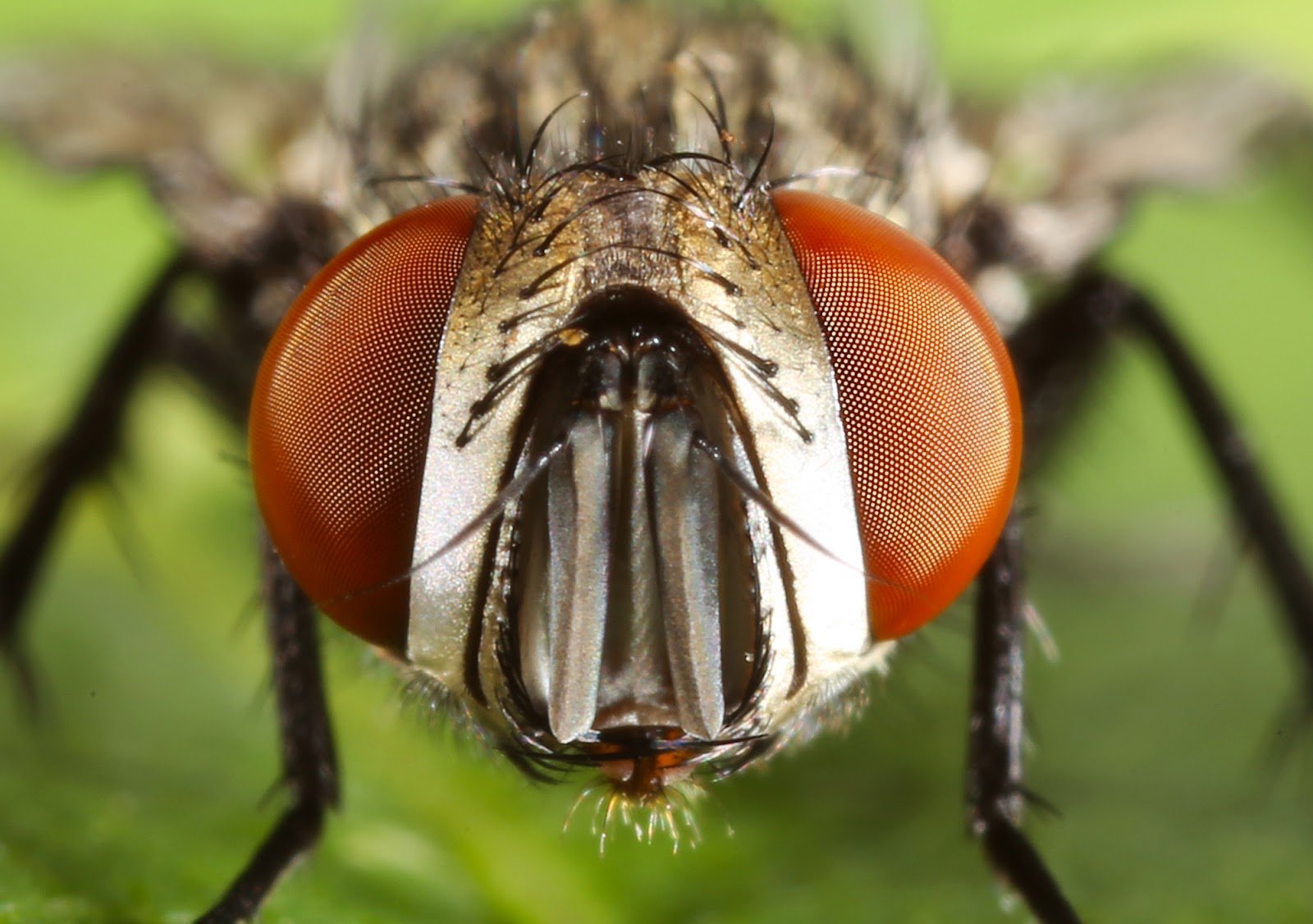
By this morning six of the eight had emerged as adult flies.  These pictures give an idea of what they look like, and the shape and color patterns on their bodies.

The two gray antenna on the front of the face seem slightly different than other flies.


The adult flies are about the size of an average house fly, and it would be difficult at first glance to notice any difference.

The pattern on the back seems a little more pronounced than some flies.

The face down below would only be appealing to another tachinid fly.

Thursday, June 6, 2013

Monarch Butterfly Eggs


 The Monarch butterflies are returning from their long spring migration which begins in Mexico.

The Monarchs that are arriving here now are the second or third generation from those that left Mexico a few months ago.

As soon as the females arrive they seek out milkweed plants and lay eggs, usually on the underside of the new plant leaves.

The eggs are tiny but beautiful with amazing detailed design as can be seen in the picture above.
 The eggs are tiny, only one millimeter high and half that wide, or about 1/32 of an inch wide.

The egg in this picture can just be seen at the tip of the middle leaf, where the little creamy white dot is.

The eggs in these pictures were laid this past Monday morning, and I took the pictures last evening, except for the picture of the butterfly, which I took last fall.
 Here is another egg on the underside of a different leaf.  On the small patches of Common Milkweed and Swamp Milkweed in my garden there were about 25 eggs that I found.  There were less plants than that.

What I find amazing and mysterious is how the female Monarch can distinguish the tiny milkweed plants from all the other native prairie plants in the garden.


Many of these little eggs will be parasitized by even smaller wasps, or the caterpillars parasitized by a local fly.  So, not many make it to become an adult butterfly.

The milkweed leaves look kind of smooth until a closer look is taken. Then they become fuzzy jungles of thick growths on the leaf surface. 


I cut the edge of the leaf off to get the camera in close here, where two eggs can be seen.  The one on the left is the one in the top picture of this blog post.  The eggs are 5/8 of an inch apart, or 16 mm.

Looked at very close like the top picture these eggs look similar to the giant eggs in the movie Alien.  It is not too hard to see that sci fi special effects people look to real nature for their ideas.

I will try to get pictures of the eggs hatching and post them soon.  It normally takes 3 to 4 days for the eggs to hatch, so sometime tonight or tomorow.

Friday, August 29, 2014

Monarch Butterflies Start Migration

In Springbrook Nature Center's south prairie the Rough Blazing Star is in full bloom and the Monarch Butterflies are busy drinking nectar as they start their long migration to Mexico. 

I took these pictures on Tuesday with Monarch butterflies all around me, seeming to have added to their numbers this summer after reports of serious population decline last spring.
 I'm sure they are still in serious decline, but it is great to see them in numbers after seeing so few recently. 

This is a male, as told by the black "spots" on the hind wings.


Although there were plenty of flowers to go around, the butterflies often nectared together on a single plant, with 3 or 4 close together, as can be seen in the picture below.

Sunday, June 23, 2013

Monarch Caterpillar Prepares to Become Chrysalis

 To become an adult butterfly the Monarch caterpillar must go through complete metamorphosis.  Which means it needs to go through a pupal stage to emerge as a butterfly. 

This Monarch caterpillar is preparing to become a chrysalis, its pupal stage.  First it creates a silk "button" to securely attach itself to as it goes through the very inactive chrysalis period.
 It makes the "button" with the silk threads that come from its mouth.  This process takes about an hour, as it weaves threads all around the plant stem to secure the "button" in place.
 Once finished the caterpillar turns its body around and attaches the last pair of pro-legs to the button.  It seems to be a bit like velcro.
Here the little hairs on the pro-legs can be seen.  The caterpillar wiggles this around until it is satisfied that it is attached properly.


Now the caterpillar quiets down for a few minutes, and then slowly begins to let all its true and false or pro legs loose from the plant stem.
 Here you can see that the caterpillar is only holding on with one pair of its pro-legs. 


It very slowly lets its body down and then lets loose with this last leg hold.
Now the caterpillar is in what is called the "J" form or position. 

It will stay in this position for about 18 hours while its internal body makes significant changes. 

This is its last act as a caterpillar.  At the end of the 18 hours, its skin will split and a beautiful chrysalis will be revealed.

The next post will show that process.

Saturday, July 6, 2013

Monarch Butterfly Emerging From Chrysalis

 On July 1st, the Monarch Butterfly that I have posted earlier as an egg and then a caterpillar, emerged from its chrysalis.  This picture is from two days after it formed the chrysalis, and shows the beautiful jade green color that the chrysalis has.
 This picture was taken on day eight as a chrysalis.  Tiny areas of color are beginning to  show where the feet and antennae are.

The gold decoration spots are just that and serve no purpose other than camouflage, although they don't look like an attempt to blend in.

The forming butterfly inside is itself green, as the outer skin is completely transparent.  So it needs to make big changes in the next 48 hours to have the bold colors of a Monarch Butterfly.
 Here is the chrysalis on day 10.  Once the skin looks this clear the butterfly will emerge within an hour.  Lots of color change did happen!


The chrysalis is completely still for the entire ten days, making no movement after the first few hours when it formed.


Now, just before it emerges, small movements can be seen through the camera lens around the legs and head.
Very quietly the chrysalis skin splits and the butterfly begins to emerge. It hangs on with its feet and pushes its body and wings out of the skin.  

In the pictures below the new butterfly drops completely out and struggles to get a leg hold outside the chrysalis skin.

From the instant the chrysalis skin breaks open the butterfly is pumping fluid from its abdoman into the wings, even while it emerges from the chrysalis.

Note how big the abdoman is and how small the wings are in the pictures below. 

Within an hour the wings are fully extended, but are very limp, and need to harden. The butterfly turned and moved around quite a bit on the old skin while pumping fluids into its wings.


 Four hours later the butterfly was opening and closing its wings.  The wings were hard enough for short flights.


I took the butterfly outside and  put it on the wild Vervain in the garden.  After a few seconds it flew off into the sky.


I only had time for a couple of pictures, one below, before it was gone.

It took 27 days for the entire process from egg to flying away as a butterfly.  3 days as an egg, 14 days as a caterpillar, and 10 days as a chrysalis.  With luck, the butterfly will live for several weeks.  Enought time to start the next generation.

Saturday, November 27, 2010

Monarch Chrysalis


Watching a butterfly break open and emerge from its chrysalis is very cool.  Within seconds this Monarch Butterfly's abdomen drops. One of the butterfly's first actions is to zip the double proboscis into one tube. It takes about an hour for the fluid from its abdomen to get pumped into the wings, and another 12 to 24 hours for the wings to dry hard so the butterfly can fly. Can you see the scent pouch bulge on the third wing vein from the body that identifies this as a male?

Monday, June 10, 2013

Monarch Butterfly Egg Hatching

 Here is the picture of the Monarch Butterfly egg that I posted a couple of days ago.  The egg looked like this for 3 days, but then changed overnight to look as it does below.  The egg "shell" below has become transparent and the baby caterpillar can be seen inside.  The large black area is its head and the black body hairs can be seen also.

While I was photographing it the baby caterpillar could be seen moving around inside the egg!
 The egg could be seen moving a bit, bulging and swaying as the caterpillar prepared to find its way out.

At almost exactly 96 hours from being laid, the little caterpillar began chewing a hole in the top part of the egg, as can be seen in the picture below.
 At this point small mouth parts with several rough "teeth" like claws could be seen tearing at the egg shell and the caterpillar seemed to be eating the small pieces.
 In this picture the left big black "eye" can be seen, with little tiny eyes, the ocelli, in a half circle to the lower right of the large black eye, in addition to the mouth munching on the egg shell at the bottom.

In the picture below the caterpillar sticks its head out for a quick first view of the world.

In the following pictures below, the caterpillar leaves the egg completely.

 At this point it became difficult to determine a focus point, as the caterpillar kept moving out of focus, which was less than a tenth of a millimeter.

It took the caterpillar less than one minute to leave the egg, once it decided it was time to go.
 Here the three right side "true" legs can be see.

I think the caterpillar is thinking hard here trying to figure out how to make the other legs work.
 In this picture three of the right pro-legs are out, waiting for the next to last pair to begin to function.

The egg is only one millimeter wide, so the newly hatching caterpillar, measured with a ruler, was exactly 3 millimeters long.
"Finally!  Whew! That was hard work, think I'll take a little rest for a minute."  At least that is what I would have been thinking  if I was the caterpillar.

The beginnings of the 4 black "antennae" can be seen on the caterpillar's back.  Two in front and two in back. These will become tentacles and function as sense organs but not actual antennae.
 The caterpillar turned around and ate part of the egg for a few minutes, and then seemed to loose interest.
 The entire hatching process from first chewed opening to this point took about an hour of pretty steady work. But the caterpillar left to explore within a few minutes.

All three eggs I was watching hatched within an hour of each other, but the ones outside on the plants took two more days, so colder temperatures must make a difference in how fast the eggs hatch.
 Exploring is fun, but this caterpillar is looking for a safe place to begin eating.
 "Hmmmm, I wonder if I can crawl upside down without falling off. "  Which is exactly what this one did.
 Twentyfour hours later the caterpillar was doing a good imitation of the book title of "The Very Hungry Caterpillar."  Small dark bands can be seen on the caterpillar now.

48 hours old in the picture below and the black and yellow and white bands are beginning to show.  And much larger holes where it has been eating. 

At 48 hours the caterpillar is now 6 millimeters long, twice as long as at hatching.