Tuesday, November 11, 2014

Purple Finches Arrive With First Winter Storm

 There were several Purple Finches at my bird feeders this morning.  The first ones this year, and just in time for the first big snowstorm of this new winter.

This male was waiting for an open space on the feeder. He soon was eating seed as can be seen below.

The females do not have the purple-cranberry color, but are distinctive with the white line over the eye, as can be seen in the picture at the bottom.


Friday, October 24, 2014

Yellowlegs Shorebirds Migrating South

 Most shorebirds have already migrated through Minnesota on their southward journey, but this Greater Yellowlegs was near the shore of the Mississippi River yesterday and allowed me a fairly close approach. It is usually difficult to get close to these birds.

This bird seemed to be resting, eating, and preening its feathers as it prepared for the next leg of its migration to the southern coasts of the United States or somewhere in Central America.

Yellowlegs nest in Canada, so we only get to see them during migration
 Here is a picture with a female Mallard Duck in the foreground for size comparison. The long bill and fairly large size differentiate this from a Lesser Yellowlegs, which also migrate down the Mississippi Migration Flyway.

The bright yellow legs are distinctive in these birds.


Here this bird is looking for food, and in the next picture is seen grabbing something only it can see under the water.
 I didn't see anything wiggling in its mouth when it came back up, so it must have eaten it while under water.  With ducks and gulls all around it, food seen in its mouth would bring other birds eager for a meal.

After eating a little, and resting, then preening, as seen in the picture below, this bird flew off to another spot for more food and rest.

Next spring it will make the return flight to Canada, passing through this same area looking for food and rest to give it the resources it needs to fly thousands of miles to its breeding grounds.

Solar Eclipse At Springbrook Nature Center

 Yesterday in the late afternoon a partial eclipse of the sun occurred all across North America. It was a perfectly clear day and easy to see.  I took these pictures at Springbrook Nature Center at about 6 PM as the sun was setting.

With this eclipse and the total eclipse of the moon earlier this month, it has been a rare sky focused time.
In this picture the sun was dissappearing into the trees of Springbrook as it set, with the partial eclipse still obvious.

The moon moving between the earth and the sun causes this eclipse, but the moon can not be seen, since the sun is lighting its other side.

Friday, October 17, 2014

Mallards and Wood Ducks at Springbrook to Migrate Soon

 Ducks at Springbrook Nature Center are getting ready to migrate.  It is easy to see the Mallards and Wood Ducks in the wetlands off the boardwalks right now, as they spend most of their time eating.

This male Wood Duck is one of the most colorful ducks in North America and and is easily seen from the boardwalk.
 The female Wood Ducks are much less colorful, but almost always together with the males at this time of year.

The Wood Ducks are usually at the edges of the wetlands, and a bit more secretive than other ducks.
 The Mallards are common and easy to get close to.  This pair were within a few yards of the boardwalk, and taking a rest from their busy eating schedule.

As you can see below, their time is mostly spent eating plants that can be reached just under the surface of the water.  Bottoms Up!

Blood Moon Eclipse

A week ago there was a full eclipse of the moon on a very clear early morning, which many people either watched, or viewed pictures of. 

I took this picture at 10 PM, six hours before the eclipse started. 

In the picture below you can see how the moon changes position, at least from our perspective, turning a bit clockwise, over the next 6 hours.

The internet said the eclipse would begin at 4:25 AM, but at 4:00AM it had already begun in my location, so I was glad I had taken this picture of the whole moon earlier.
 This picture was taken at 4:15 AM, and from here-on the moon moved fairly quickly into the Earth's shadow, as can be seen in the following photos.

As the shadow "moves" across the moon, the limitations of photography, compared to human eyesight, become apparent.

To the camera it looks like the area on the moon that is in shadow is completely dark.  But our eyes are able to see the red glow of the dark moon area caused by the "halo" of reddish sunrises/sunsets happenning all around the edges of the Earth.  This is where the term "Blood Moon" comes from.
 This picture was taken at 4:40 AM,  The moon was getting fairly low in the sky here, and I had to move my tripod to not have tree branches interfere with the picture.
 By 4:55 AM the moon was nearly 2/3rds in the shadow, and nearing total eclipse.
 By 5:11 AM only a crescent of the moon was visible from sun light reflection.

But as you can see in the picture below, the red "Blood Moon" was very visible over the rest of the surface of the moon.

The pictures here are all taken at about 125th of a second because the moon is quite bright in the camera lens.  But the "Blood Moon" is quite a bit darker and required a slower shutter speed of about 1/5 of a second.


The white area on the right side of this picture is the regular moon light, which has to be overexposed to be able to see the red area.  This picture was taken at 5:11 AM, the same as the picture above.

At 1/5th of a second through a 600mm lens the moon actually moves a little as it is setting, making it difficult not to have some blurring when taking the picture.

From my place to take these pictures the moon lowered into the trees nearby and was gone for photography purposes after this picture.

Sunday, September 14, 2014

Wooly Bear Caterpillar Weather Predictor?

 Wooly Bear Caterpillars are busy finding a place to hibernate for the winter, and walk busily in front of anything in their search. So lots of sightings are being made now.   Here are pictures of two caterpillars I have found in the last few days.

Folklore seems to have made sure that everyone hears the story that the amount of brown on these caterpillars is a predictor of how severe the winter will be.
Supposedly, more brown means a less severe winter.

Here in Minnesota we are always looking for a reliable winter prediction, even if from a caterpillar.

Folklore is fun and will persist, but science and observation helps to give some understanding of why these caterpillars may look different sometimes.


Eggs are laid in late summer and early fall when these caterpillars hatch and start to grow.


After hatching they eat several plants that grow in our lawns, and shed their skins as they grow.  They shed 6 times, and each time the black bands get wider and the brown gets narrower, but the furry bristles get thicker with each shedding as well. 

When cold weather sets in the caterpillar finds shelter under some bark or other protected place and hibernates, freezing solid!

When warm weather returns the caterpillars revive, eat a little, then form a cacoon, and after a few weeks an Isabella moth emerges, and the cycle starts over.


So, what do you think?  A long hard winter or a short easy one?

Friday, September 12, 2014

Tiger Swallowtail Butterfly Caterpillar

 Almost everyone has seen the beautiful and gracefull Tiger Swallowtail butterflies that visit our gardens in mid summer. 

As the flowers and warm weather have dissappeared, the butterflies have as well.


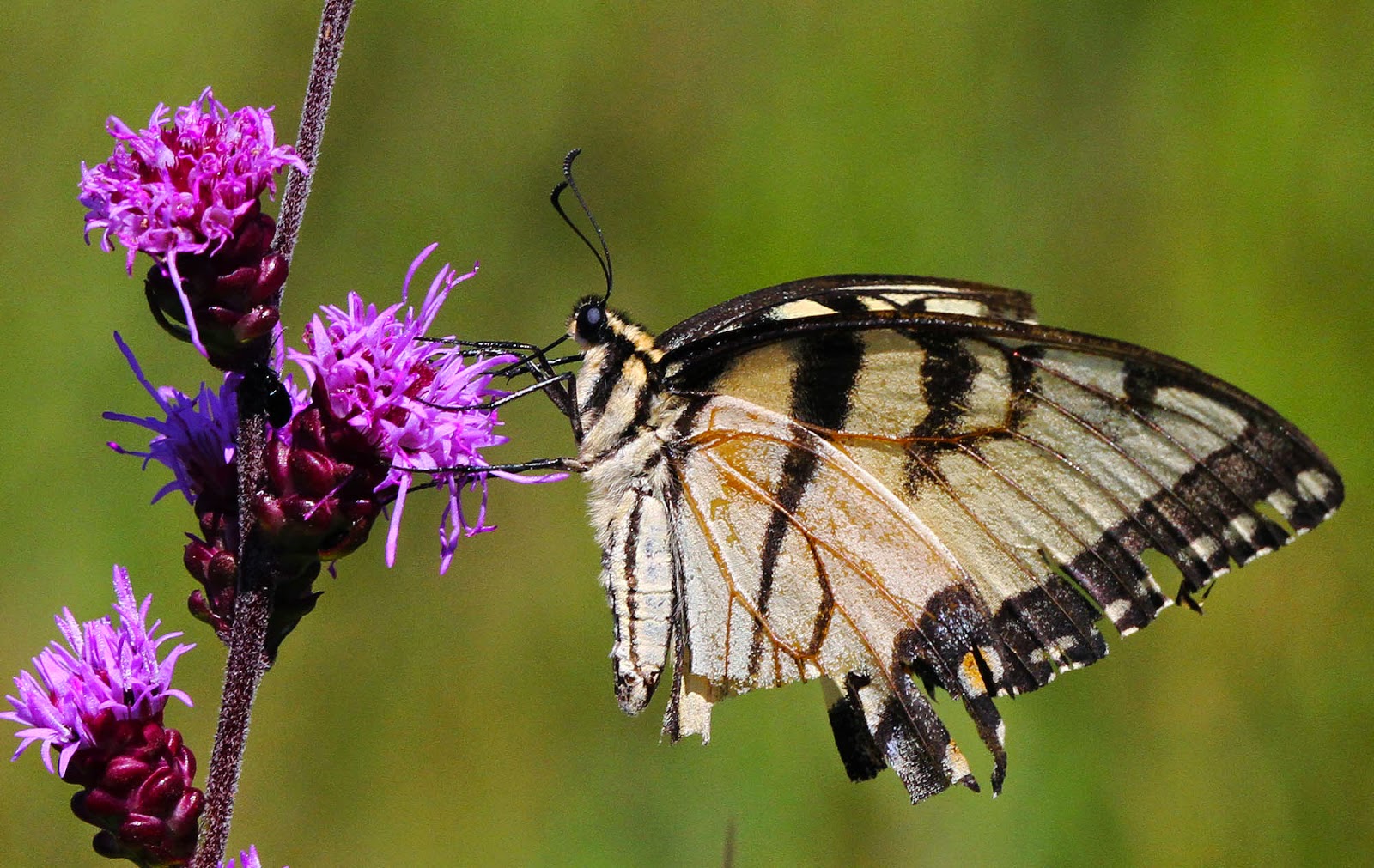
 I saw this old and bedraggled looking one last week in the prairie.  I was surprised it could still fly from flower to flower.

While these butterflies are now gone their caterpillars are finishing growing and looking for a place to make a chrysalis for the winter. 
 Tiger Swallowtail butterfly caterpillars have some distinctive features.

They are a basic green like many caterpillars, but they have special "eye" markings to use in defensive situations.

When danger approaches they pull their head back into their body, swelling the front part of their body, making it look like the scary picture below.

If that doesn't work the caterpillars have brightly colored orange scent organs they extrude from their head that emit a bad odor. 

It's defenses seem to be working for this caterpillar so far.