Thursday, March 27, 2014

Spring Robins

 Flocks of Robins arrived on migration last night and were actively eating last fall's crab apples off the tree in my yard this morning in the mist. There were often eight ot ten in the tree at once.

Many other Robins were flipping leaves in the garden where the sun has melted patches of snow, giving access  to little creatures hiding under the leaves waiting for a warm day.

Additional Robins were under the crab apple tree eating the little apples that fell off.

It was a busy place early this morning.
 The little crab apples are small but nutritious, causing the Robins to sometimes fend off what they saw as competitors for what they felt was their food find.
 There were many Cedar Waxwings feeding on the crab apples as well.  Most of them have been here all winter, so why they waited until the Robins arrived to try this food source is a mystery.

Both male and female Robins seemed to be in the flocks of newly arrived birds, so nesting will probably begin very soon.

Tuesday, March 11, 2014

Crows

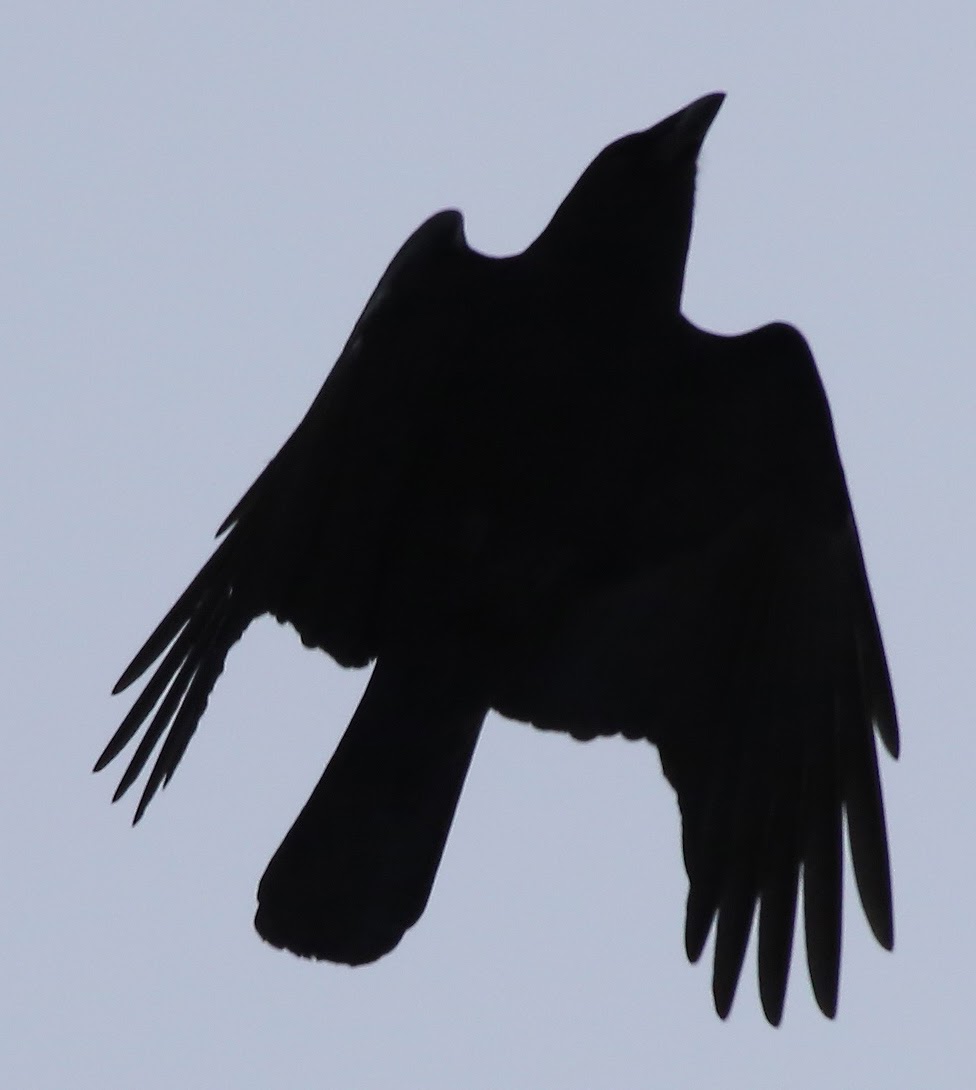
 Everyday this winter in late afternoon hundreds and hundreds of crows fly over my house on their way back to their communal roost in Minneapolis. Many thousands roost there where safety in numbers allows most to survive predators like Great Horned Owls.
 The lighting is usually poor, but it is a great opportunity to try to photograph them as they pass by at full speed, talking to each other.
 They often have little bits of something in their mouth, like this one has.  Perhaps a midnight snack.

These crows spread out every morning in every direction from downtown Minneapolis to forage for French Fries and other suburban food, then return at dusk for the night.

But very soon now they will break up into pairs or family groups to set up territories in our back yards and begin building nests for this year's young.

Monday, March 10, 2014

Ice Caves at Apostle Islands Lakeshore

 My photography is usually of living things, and mostly at Springbrook Nature Center, but the rare opportunity to walk out to the ice caves at the Apostle Islands National Lakeshore was too good to pass up.

The caves along the shore of Lake Superior in Wisconsin are under red rock cliffs and so normally inaccessible in winter unless the lake freezes.
 Lake Superior has not been freezing in recent years, but this year froze completely over, making the caves accessible after a hike of a bit more than a mile over the ice and snow.

The ice forms from crashing waves that hit the rock, turning to many forms of ice in the extreme cold. I took these pictures on Sunday, March 2nd, with temps below zero and strong winds adding to the adventure.
 The caves have been formed over thousands of years of wave action on Lake Superior, and stretch for 2 miles along the shore, facing west, so late afternoon sun lights up the different ice forms.

It is hard to get a sense of the size of the ice and caves without people in the pictures, so some of these pictures have people for perspective.
 It is hard to understand why there are ice formations in some places and not others within the many caves.  Is it wave water leaking down from above, or just the way the waves hit the walls in each cave?

Some of the caves are quite large, and others very small, and all sizes in between.
 The floor is very slippery ice in all the caves, and often looks as though a wave just froze in place.
The rock in this cave had tree-like rings around the domed ceiling, causing these rounded bands of 2 and 3 foot long ice cycles to hang from the edges of the rings. 
 This same cave had beautiful, mounded globe-like sculptures with a floor of frozen waves.
There were different colors in the ice in different places.  This spot had very green ice, lit from a small opening in the cave to the outside
These caves are beautiful to see, in winter as well as in summer.  The only way to see them in summer is with a canoe or kayak on a calm day. 

The walk to the caves will still be open while the ice lasts, which could change any day, so plan a visit very soon to enjoy this rare chance to visit these caves and their ice formations in the winter.

Wednesday, January 8, 2014

Winter Birds Take Water Baths At Minus 22 Degrees Below Zero

 Having liquid water available for birds in this extreme cold can be very important for their survival.  They need water to stay alive, but it is hard to find drinking water at -22 degrees below zero.

My heated water bath/feeder has been a popular place the last few days. It has a fringe of delicate frost grown from the mist rising off the water
 The water is only a few degrees above freezing but that was 50 degrees above the air temperature on Monday morning!  Mist swirls up from the water surface as this Goldfinch takes several drinks.

Many finches at a time are often perched around the edge of the water.
 This Blue Jay has to tip his head back to let a bill full of water flow back into its throat.  It does this several times before flying to the seed tray nearby. 
 This female Cardinal seems to be enjoying the warm mist as she waded out to the middle of the water this morning.
 This male Cardinal was braver and jumped right in for a regular bird bath this morning when the temperature reached a balmy -11 degrees below zero.
 He was not the only bird to do this.  A Starling and several House Sparrows also took baths and seemed to enjoy their time in the water. 

There must be some advantage to water bathing at these cold temps.  But only a few birds seem inclined to do it.

Burrrrrrrrrrrr!

The Cardinal below has oily feathers to shake the water off.  The House Sparrow below is showing off making designs with water spray.


Monday, January 6, 2014

Cardinals and Blue Jays Have Frosty Eyes at 22 Degrees Below Zero

 This Cardinal was at my feeders this morning with a temperature of 22 degrees below zero F.  Both the Cardinals and the Blue Jays had frost around their eyes.  I have not seen this before.

The moisture from their breathing must have condensed in the extreme cold onto the feathers around their eyes.

After an hour or so the frost particles were gone, and did not seem to effect the birds in any way, but it made them look odd.
 The frost was on the feathers around both eyes, and broke loose in little pieces.
 At these very cold temperatures the birds need to eat to stay alive, so I was able to get close to take these pictures.
 This Blue Jay had quite a lot of frost at first light, but did not sit still to pose for pictures.  Grabbing a mouthful of seeds it would fly away and eat them, then return for more to hide or eat.
 I think the picture below pretty much gives a sense for how these birds feel about this very cold weather.

This is the true test for survival for these birds and all living things needing to find food on an hour by hour basis in this cold.

Monday, December 9, 2013

Cardinals, Blue Jays and Sharp Shinned Hawks at Feeders

 With the below zero weather we are having the birds are at the feeders all day to keep energy levels high enough to ward off the cold.

And they bring lots of color, too.  The Cardinals, with their bright red are among the brightest colors to see.
 The big beak on the Cardinal can easily open the hardest seeds on the feeder.

At Springbrook Nature Center's bird banding yesterday in the falling snow we caught over 85 birds that were stocking up on energy for the cold night coming up.

Several Cardinals were captured, banded, and released.
 We don't often catch Blue Jays at banding activities as they are too large and wary to get caught in the traps, but we caught several yesterday, which shows how desperate all of these song birds are for the food at our feeders during winter storms.

It is easier to photograph them too, as they are concentrating on the food, and let me get a bit closer, as this one did yesterday.
 The Blue Jay's blue colors make a great contrast to the red of the Cardinals. 

The Blue Jays are big and can become bullies at the feeders, not letting other birds near them until they are done feeding and leave.
Because of all the many little birds feeding around the feeders, this Sharp Shinned Hawk stopped by this morning to see if one was slow enough to become breakfast.  None were on this pass, and the hawk stayed for less the one minute before moving on.  I was only able to get two pictures before it was gone.

The predators need to eat too, and they keep the flocks of song birds healthy by eating the slow and less fit.  And they are a wonder to watch with their fast flying and manuerving ability.

Thursday, November 14, 2013

American Coot Strange Migrating Waterfowl

 Coots are one of the last of the waterfowl migrating through Springbrook right now. I took these pictures from the boardwalk during the bird banding program last Sunday.

Coots are not ducks, but they are found among ducks.  They are more closely related to rails and cranes. They have a bill shaped like a rail, and each toe has its own webbing, instead of the whole foot being webbed together as ducks have.  Some of the webbing on the toes can be seen in the picture below.