If you have ever found caterpillars on your dill plants in your garden they are almost certainly the Black Swallowtail Butterfly caterpillars like the ones seen in these pictures. My son found these on his dill.
Black Swallowtail Butterflies lay their eggs exclusively on plants in the carrot family. In the wild in this area that means Golden Alexander plants, and, south of Minneapolis, Queen Ann's Lace. In your garden it means dill, parsley, and carrot.
The caterpillars eat the entire dill plant, right down to the ground.
Butterfly and moth catterpillars all grow through what are called 5 "instars" or growth stages. With each new instar the caterpillar sheds its skin and is able to grow larger.
In each instar the larvae usually look a bit different, or maybe a lot different.
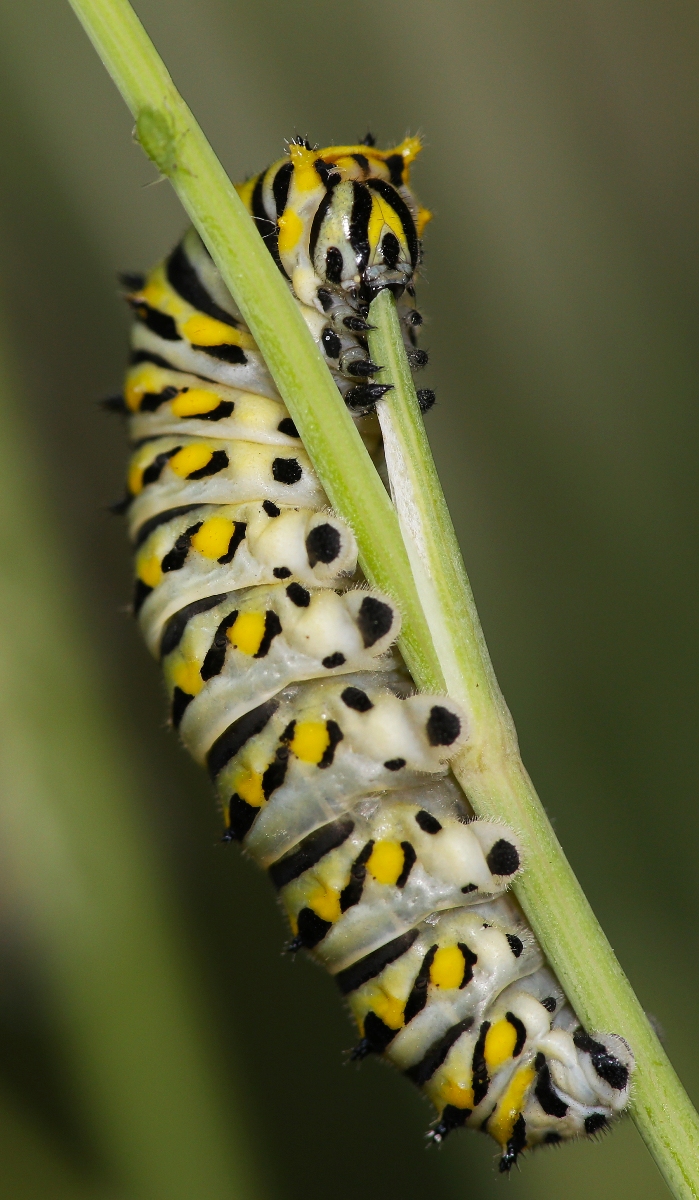
This picture is of the 3rd instar for the Black Swallowtail caterpillar. It is preparing to shed its skin here. It quietly sits still on the plant stalk for several hours, not its normal behavior.
Notice all the spines and tubercules on the caterpillar's back. These will get smaller with each instar until they are not present in the 5th or last instar.
Also notice the white 'saddle' in the middle of the back in this picture. This will disappear in the next instar, as can be seen in the picture below.
Notice also the silk threads the caterpillar has woven all around the stem so the old skin will stay attached as it splits and the 'new' caterpillar moves forward.
Here the caterpillar above has just shed its skin. Basically it just crawled out of it during the night time. The skin fell off the stem before I could reposition the camera for a better angle.
Here is the caterpillar in the 5th and final instar. All the spines and tubercules are gone now, and the caterpillar uses its colors to blend in and not be seen by predators.
The caterpillar is about 3 inches long here, 3 times the length it was in the 3rd instar, which is the 2nd picture above.
It is pretty easy to see the difference between the six 'true' legs up by the head and the 10 'pro-legs' or 'false' legs that protrude from the caterpillar's abdoman.
These false legs are like little velcro pads that stick to plant surfaces very well, enabling the caterpillar to use the true legs to help grab and pull food towards its mouth.
Here you can see the sharp edged 'jaws' pulling in the dill flower, along with a lot of pollen that has stuck to its face from all the other flowers it has eaten in the previous day.
I don't think these caterpillars help with fertilization of the flowers since they completely eat every flower, and stem, they can find.
Notice the aphid trying to escape at the bottom of the flower stem. I didn't notice the aphids until after I was looking at the pictures on the computer.
It soon became obvious that every flower had its group of aphids that were soon to be deprived of their home and food as the caterpiller ate it all. They were very tiny, and trying to figure out where to go.
The caterpillars seemed bothered by the aphids when they crawled onto their bodies, especially when the caterpillars were little. But I never saw one get eaten, even if it was on the flower as the caterpillar ate the flower.
All swallowtail butterflies have a brightly colored scent gland that is flashed out and emits a strong odor when danger threatens. Black Swallowtail caterpillars are no exception. But these caterpillars did not seem threatened by me poking them, so this is the best photo I was able to get. The orange gland is only about half way out here, and the air was filled with a strong dill/citrus odor.
At about 2 weeks of age the caterpillars start to wander, and after doing this for 12 hours or so, they settle on a plant stem to their liking, and attach themselves with a silk thread as can be seen below. Now it is ready to transform into a chrysalis, which will appear in an upcoming post.
Sunday, August 25, 2013
Tuesday, August 6, 2013
Mantisfly Strange Insect
I found this Wasp Mantisfly on a flower at Springbrook recently. It is not a fly or a mantis or a wasp, but is related to the lacewings and similar predatory insects. It is small, on the head of a Black Eyed Susan here, but fierce looking with a temper to match.
Its colors mimic a paper wasp, but its front legs and head are very mantis like. And any small bug that it catches in its front legs is dinner for sure.
Evolution's adaptive characteristics make for some fascinating creations in nature.
Its colors mimic a paper wasp, but its front legs and head are very mantis like. And any small bug that it catches in its front legs is dinner for sure.
Evolution's adaptive characteristics make for some fascinating creations in nature.
Friday, August 2, 2013
Aphids Making Gallons of Honeydew
Ants have taken over a patch of milkweed at the nature center and they have brought their aphids with them. The aphids cover the bottom side of every leaf, excreting their honeydew, and the ants protect them and get at least some of the honeydew.
It seems very pastoral in theory, but is the most chaotic and busy place around.
While this picture seems to show the ant gently touching the aphids for a return of honeydew, it is only checking their safety in a very fast pass through the area.
With these aphids the ants don't seem to get the reward directly from the aphids at all.
But look at all the aphids under the 6 feet and legs of the ant. And this is as big as they get, although there are many very little ones.
I measured the biggest aphids here at just under one millimeter.
This little part of one leaf underside shows 106 aphids of different size.
The whole leaf had over 1,000, and there were 30 leaves on the plant, which means over 30,000 aphids on each plant. I counted 22 plants in this group, so over 660,000 aphids in this colony. Wow!
Each aphid is withdrawing fluid from the plant, and excreting little drops of honeydew constantly. Besides producing new babies and shedding their skin that is all they do.
Their drops of honeydew are tiny, but if they added up to just one water droplet in volumn in a week per aphid, that would be 660,000 drops of honeydew per week. At 27 drops per teaspoon, that is over 7 gallons a week for this colony!
Here you can see one little droplet just released by this litle gal. I have turned the picture upside down so it is easier to see, so this droplet would actually be falling up to the leaf below it, onto the topside of the leaf.
This picture is also turned over to see better, but the droplets are about to fall down, which is up in this picture.
With thousands of droplets falling onto the top surface of the leaf below you can imagine what a sweet, sticky, treasure trove the top of each leaf becomes.
The ants spend most of their time eating the resulting droplets of honeydew on the top surface of the milkweed leaves.
Here you can see each tiny white spot is a droplet. The ants get fat eating these, which they can take back to the nest to feed baby ants with.
The ants also have to spend a great amount of time chasing away other critters who are interested in this enormous food source. They are not very successful.
I counted at least 5 ants on every leaf. That means there are 150 ants per plant, and 3,300 on the combined 22 milkweed plants at any one time during the day.
But other insects come to feast as well. There are at least 8 flies that I can count on each plant at any one time. Lots of them flying all around.
Many are this red eyed species that is house fly size. Its sponge/mop like mouth is picking up the honeydew, but while it eats even more honeydew rains down from the bottom of the leaf above, covering the fly with little specks of sweet dew.
Several other species of fly are also present, including this larger one.
The aphids are growing on the leaf up above and shedding their skins as they grow. The shed skins fall as well. One can be seen under the fly here. It is white.
After a few weeks of this there is mouldy honeydew, fly droppings, shed skins, and anything the wind blows onto the sticky surface. It is a mess!
Wasps and bees are attracted to the sweets also. They fly and walk rapidly from leaf to leaf to get the freshest honeydew. But the leaf top is now like a dirty parking lot. Each white spot is a shed skin that has rained down from above, with much other debris as well.
This wasp has found a relatively clean spot to search. Its antennae are constantly touching the surface looking for more.
In this picture a different wasp, a paper wasp, is eating the glistening honeydew along the edge of the leaf.
The entire top of the leaf is covered with this coating of sticky food.
Unlike the flies, this wasp is cleaning itself off after feeding for a while. Special combs on the front legs scrape off the other body parts. It worked for several minutes doing this.
Aphids can be seen on the underside of the leaf to the left. They are dropping more honeydew to the top of the leaf below.
With over half a million aphids and other food animals present, the predators show up. Several Ladybugs were hunting and eating aphids while I was photographing yesterday. The Ladybugs are too big for the ants, but there are so many aphids, they have little impact on their numbers.
This little milkweed patch is an extremely busy ecosystem. Nothing can compare to it nearby for the number of insects constantly entering and leaving, not to mention the over half million that live on it every day.
It seems very pastoral in theory, but is the most chaotic and busy place around.
While this picture seems to show the ant gently touching the aphids for a return of honeydew, it is only checking their safety in a very fast pass through the area.
With these aphids the ants don't seem to get the reward directly from the aphids at all.
But look at all the aphids under the 6 feet and legs of the ant. And this is as big as they get, although there are many very little ones.
I measured the biggest aphids here at just under one millimeter.
This little part of one leaf underside shows 106 aphids of different size.
The whole leaf had over 1,000, and there were 30 leaves on the plant, which means over 30,000 aphids on each plant. I counted 22 plants in this group, so over 660,000 aphids in this colony. Wow!
Each aphid is withdrawing fluid from the plant, and excreting little drops of honeydew constantly. Besides producing new babies and shedding their skin that is all they do.
Their drops of honeydew are tiny, but if they added up to just one water droplet in volumn in a week per aphid, that would be 660,000 drops of honeydew per week. At 27 drops per teaspoon, that is over 7 gallons a week for this colony!
Here you can see one little droplet just released by this litle gal. I have turned the picture upside down so it is easier to see, so this droplet would actually be falling up to the leaf below it, onto the topside of the leaf.
This picture is also turned over to see better, but the droplets are about to fall down, which is up in this picture.
With thousands of droplets falling onto the top surface of the leaf below you can imagine what a sweet, sticky, treasure trove the top of each leaf becomes.
The ants spend most of their time eating the resulting droplets of honeydew on the top surface of the milkweed leaves.
Here you can see each tiny white spot is a droplet. The ants get fat eating these, which they can take back to the nest to feed baby ants with.
The ants also have to spend a great amount of time chasing away other critters who are interested in this enormous food source. They are not very successful.
I counted at least 5 ants on every leaf. That means there are 150 ants per plant, and 3,300 on the combined 22 milkweed plants at any one time during the day.
But other insects come to feast as well. There are at least 8 flies that I can count on each plant at any one time. Lots of them flying all around.
Many are this red eyed species that is house fly size. Its sponge/mop like mouth is picking up the honeydew, but while it eats even more honeydew rains down from the bottom of the leaf above, covering the fly with little specks of sweet dew.
Several other species of fly are also present, including this larger one.
The aphids are growing on the leaf up above and shedding their skins as they grow. The shed skins fall as well. One can be seen under the fly here. It is white.
After a few weeks of this there is mouldy honeydew, fly droppings, shed skins, and anything the wind blows onto the sticky surface. It is a mess!
Wasps and bees are attracted to the sweets also. They fly and walk rapidly from leaf to leaf to get the freshest honeydew. But the leaf top is now like a dirty parking lot. Each white spot is a shed skin that has rained down from above, with much other debris as well.
This wasp has found a relatively clean spot to search. Its antennae are constantly touching the surface looking for more.
In this picture a different wasp, a paper wasp, is eating the glistening honeydew along the edge of the leaf.
The entire top of the leaf is covered with this coating of sticky food.
Unlike the flies, this wasp is cleaning itself off after feeding for a while. Special combs on the front legs scrape off the other body parts. It worked for several minutes doing this.
Aphids can be seen on the underside of the leaf to the left. They are dropping more honeydew to the top of the leaf below.
With over half a million aphids and other food animals present, the predators show up. Several Ladybugs were hunting and eating aphids while I was photographing yesterday. The Ladybugs are too big for the ants, but there are so many aphids, they have little impact on their numbers.
This little milkweed patch is an extremely busy ecosystem. Nothing can compare to it nearby for the number of insects constantly entering and leaving, not to mention the over half million that live on it every day.
Tuesday, July 16, 2013
Skinks, Lizzards, and Lyme Disease
This Northern Prairie Skink was on the pavement a few feet in front of the entry doors at Springbrook a few days ago. I put it on some tree bark to photograph it and was surprised to notice a Deer Tick, or Black Legged Tick, attached and behind the right front leg. These ticks transmit Lyme disease to humans.
Prairie Skinks are fairly common lizzards found in this area.
This one is an adult and about 8 inches long. I was surprised to see the Deer Tick on this lizzard, as I was not aware that these ticks feed on reptiles.
With a little research I discovered it is common for them to feed on reptiles, and even more surprising, researchers have discovered that western fence lizzards have a protein in their blood that kills the Lyme disease bacteria.
So, if an infected tick, as a young nymph, first feeds on a lizzard, it will be free of Lyme bacteria and will not transmit the disaese to us, or anything else, later on, according to the researchers.
I hope more research proves skinks have the same bacteria killing protein, since western fence lizzards don't live around here.
Prairie Skinks are fairly common lizzards found in this area.
This one is an adult and about 8 inches long. I was surprised to see the Deer Tick on this lizzard, as I was not aware that these ticks feed on reptiles.
With a little research I discovered it is common for them to feed on reptiles, and even more surprising, researchers have discovered that western fence lizzards have a protein in their blood that kills the Lyme disease bacteria.
So, if an infected tick, as a young nymph, first feeds on a lizzard, it will be free of Lyme bacteria and will not transmit the disaese to us, or anything else, later on, according to the researchers.
I hope more research proves skinks have the same bacteria killing protein, since western fence lizzards don't live around here.
Monday, July 15, 2013
Butterfly Count at Springbrook
This past Saturday was the 20th annual butterfly count at Springbrook Nature Center. It was a humid, warm, overcast day. Not the kind of day butterflies enjoy, and the numbers seen reflected that.
29 people participated, so lots of eyes were looking with nets at the ready.
This American Lady butterfly was one of 17 species we spotted. Over 20 years the number of species has ranged from 10 to 24 so this year was right in the middle for the number of kinds of butterflies seen.
This Eyed Brown was another species we saw several of. In addition to species we also count how many of each kind we see. This year was the lowest ever, and by quite a bit. We saw only 40 butterflies! The lowest years prior to this were 69 in 2008 and 72 in 1997. The highest year was 2001 with 313 butterflies counted.
So the drought last year, the late, wet, cold spring this year, and other factors have combined to make it a rough year for butterfly survival.
This Common Wood Nymph was another species we saw several of. Notice none of the butterflies have their wings open. Butterflies like to warm up with the sun on their wings. But there was essentially no open sun on Saturday until late in the afternoon as we were finishing up. So I had to use flash for photography, as it was so dark.
So the butterflies kept their wings closed, making it harder to see them, since the bright colors are mostly on the inside surface of the wings.
We also saw 2 Common Buckeye butterflies in the south prairie, where we have seen them before.
The books say these butterflies do not overwinter here, but migrate up here from the south in the summer. But we have seen them every year for the last three years in the south prairie, making me wonder if they are not somehow here all year now.
I'll try to go out on a sunny day and see if I can photograph some butterflies with their wings open. Then I can post some bright colors instead of these subdued butterflies here.
29 people participated, so lots of eyes were looking with nets at the ready.
This American Lady butterfly was one of 17 species we spotted. Over 20 years the number of species has ranged from 10 to 24 so this year was right in the middle for the number of kinds of butterflies seen.
This Eyed Brown was another species we saw several of. In addition to species we also count how many of each kind we see. This year was the lowest ever, and by quite a bit. We saw only 40 butterflies! The lowest years prior to this were 69 in 2008 and 72 in 1997. The highest year was 2001 with 313 butterflies counted.
So the drought last year, the late, wet, cold spring this year, and other factors have combined to make it a rough year for butterfly survival.
This Common Wood Nymph was another species we saw several of. Notice none of the butterflies have their wings open. Butterflies like to warm up with the sun on their wings. But there was essentially no open sun on Saturday until late in the afternoon as we were finishing up. So I had to use flash for photography, as it was so dark.
So the butterflies kept their wings closed, making it harder to see them, since the bright colors are mostly on the inside surface of the wings.
We also saw 2 Common Buckeye butterflies in the south prairie, where we have seen them before.
The books say these butterflies do not overwinter here, but migrate up here from the south in the summer. But we have seen them every year for the last three years in the south prairie, making me wonder if they are not somehow here all year now.
I'll try to go out on a sunny day and see if I can photograph some butterflies with their wings open. Then I can post some bright colors instead of these subdued butterflies here.
Saturday, July 6, 2013
Monarch Butterfly Emerging From Chrysalis
On July 1st, the Monarch Butterfly that I have posted earlier as an egg and then a caterpillar, emerged from its chrysalis. This picture is from two days after it formed the chrysalis, and shows the beautiful jade green color that the chrysalis has.
This picture was taken on day eight as a chrysalis. Tiny areas of color are beginning to show where the feet and antennae are.
The gold decoration spots are just that and serve no purpose other than camouflage, although they don't look like an attempt to blend in.
The forming butterfly inside is itself green, as the outer skin is completely transparent. So it needs to make big changes in the next 48 hours to have the bold colors of a Monarch Butterfly.
Here is the chrysalis on day 10. Once the skin looks this clear the butterfly will emerge within an hour. Lots of color change did happen!
The chrysalis is completely still for the entire ten days, making no movement after the first few hours when it formed.
Now, just before it emerges, small movements can be seen through the camera lens around the legs and head.
Very quietly the chrysalis skin splits and the butterfly begins to emerge. It hangs on with its feet and pushes its body and wings out of the skin.
In the pictures below the new butterfly drops completely out and struggles to get a leg hold outside the chrysalis skin.
From the instant the chrysalis skin breaks open the butterfly is pumping fluid from its abdoman into the wings, even while it emerges from the chrysalis.
Note how big the abdoman is and how small the wings are in the pictures below.
Within an hour the wings are fully extended, but are very limp, and need to harden. The butterfly turned and moved around quite a bit on the old skin while pumping fluids into its wings.
Four hours later the butterfly was opening and closing its wings. The wings were hard enough for short flights.
I took the butterfly outside and put it on the wild Vervain in the garden. After a few seconds it flew off into the sky.
I only had time for a couple of pictures, one below, before it was gone.
It took 27 days for the entire process from egg to flying away as a butterfly. 3 days as an egg, 14 days as a caterpillar, and 10 days as a chrysalis. With luck, the butterfly will live for several weeks. Enought time to start the next generation.
This picture was taken on day eight as a chrysalis. Tiny areas of color are beginning to show where the feet and antennae are.
The gold decoration spots are just that and serve no purpose other than camouflage, although they don't look like an attempt to blend in.
The forming butterfly inside is itself green, as the outer skin is completely transparent. So it needs to make big changes in the next 48 hours to have the bold colors of a Monarch Butterfly.
Here is the chrysalis on day 10. Once the skin looks this clear the butterfly will emerge within an hour. Lots of color change did happen!
The chrysalis is completely still for the entire ten days, making no movement after the first few hours when it formed.
Now, just before it emerges, small movements can be seen through the camera lens around the legs and head.
Very quietly the chrysalis skin splits and the butterfly begins to emerge. It hangs on with its feet and pushes its body and wings out of the skin.
In the pictures below the new butterfly drops completely out and struggles to get a leg hold outside the chrysalis skin.
From the instant the chrysalis skin breaks open the butterfly is pumping fluid from its abdoman into the wings, even while it emerges from the chrysalis.
Note how big the abdoman is and how small the wings are in the pictures below.
Within an hour the wings are fully extended, but are very limp, and need to harden. The butterfly turned and moved around quite a bit on the old skin while pumping fluids into its wings.
Four hours later the butterfly was opening and closing its wings. The wings were hard enough for short flights.
I took the butterfly outside and put it on the wild Vervain in the garden. After a few seconds it flew off into the sky.
I only had time for a couple of pictures, one below, before it was gone.
It took 27 days for the entire process from egg to flying away as a butterfly. 3 days as an egg, 14 days as a caterpillar, and 10 days as a chrysalis. With luck, the butterfly will live for several weeks. Enought time to start the next generation.
Friday, July 5, 2013
Orchard Orioles Nesting
Orchard Orioles are nesting now in the Twin Cities area. I took these pictures yesterday, on July 4th, early in the morning.
Orchard Orioles are closely related to Baltimore Orioles, in fact were considered the same species until recently. The male Orchard Oriole is quite dark though, with a rusty red breast instead of bright orange and yellow like the more common Baltimore Oriole
The female (and male) was busy catching food for the four hungry babies that were constantly calling for a meal.
She obviously does not have the black head color, or the rusty red of the male.
Both adults were hunting in the low bushes and wildflowers in the prairie near the nest. They had no trouble finding caterpillars, moths, and katy-dids for meals for their hungry brood.
The nest is courser and more sturdy than the hanging nest of the Baltimore oriole, and made of grasses woven together.
They weave the living leaves into the nest as well, making it very difficult to see the adults and babies when they feed. I had to stand on a ladder to get to the one opening that existed to see the young and adult at the same time.
Here you can see this baby is ready to fledge, or leave the nest. It is standing on the edge of the nest, and almost jumping out of the nest when the parents come with food. It was actually off the nest on a branch once, but hopped back in.
The adults know that the babies are ready to fledge, and are beginning courtship behavoir for their 2nd nest of the summer.
Here the male has brought food for the female, and she has accepted it. A few seconds later they were observed mating, and then he brought her food again.
I thought they would wait until a week or so after fledging occurred, but this suggests they will move right into a second nesting quite quickly.
Orchard Orioles are closely related to Baltimore Orioles, in fact were considered the same species until recently. The male Orchard Oriole is quite dark though, with a rusty red breast instead of bright orange and yellow like the more common Baltimore Oriole
The female (and male) was busy catching food for the four hungry babies that were constantly calling for a meal.
She obviously does not have the black head color, or the rusty red of the male.
Both adults were hunting in the low bushes and wildflowers in the prairie near the nest. They had no trouble finding caterpillars, moths, and katy-dids for meals for their hungry brood.
The nest is courser and more sturdy than the hanging nest of the Baltimore oriole, and made of grasses woven together.
They weave the living leaves into the nest as well, making it very difficult to see the adults and babies when they feed. I had to stand on a ladder to get to the one opening that existed to see the young and adult at the same time.
Here you can see this baby is ready to fledge, or leave the nest. It is standing on the edge of the nest, and almost jumping out of the nest when the parents come with food. It was actually off the nest on a branch once, but hopped back in.
The adults know that the babies are ready to fledge, and are beginning courtship behavoir for their 2nd nest of the summer.
Here the male has brought food for the female, and she has accepted it. A few seconds later they were observed mating, and then he brought her food again.
I thought they would wait until a week or so after fledging occurred, but this suggests they will move right into a second nesting quite quickly.
Subscribe to:
Posts (Atom)


