Monday, June 10, 2013

Monarch Butterfly Egg Hatching

 Here is the picture of the Monarch Butterfly egg that I posted a couple of days ago.  The egg looked like this for 3 days, but then changed overnight to look as it does below.  The egg "shell" below has become transparent and the baby caterpillar can be seen inside.  The large black area is its head and the black body hairs can be seen also.

While I was photographing it the baby caterpillar could be seen moving around inside the egg!
 The egg could be seen moving a bit, bulging and swaying as the caterpillar prepared to find its way out.

At almost exactly 96 hours from being laid, the little caterpillar began chewing a hole in the top part of the egg, as can be seen in the picture below.
 At this point small mouth parts with several rough "teeth" like claws could be seen tearing at the egg shell and the caterpillar seemed to be eating the small pieces.
 In this picture the left big black "eye" can be seen, with little tiny eyes, the ocelli, in a half circle to the lower right of the large black eye, in addition to the mouth munching on the egg shell at the bottom.

In the picture below the caterpillar sticks its head out for a quick first view of the world.

In the following pictures below, the caterpillar leaves the egg completely.

 At this point it became difficult to determine a focus point, as the caterpillar kept moving out of focus, which was less than a tenth of a millimeter.

It took the caterpillar less than one minute to leave the egg, once it decided it was time to go.
 Here the three right side "true" legs can be see.

I think the caterpillar is thinking hard here trying to figure out how to make the other legs work.
 In this picture three of the right pro-legs are out, waiting for the next to last pair to begin to function.

The egg is only one millimeter wide, so the newly hatching caterpillar, measured with a ruler, was exactly 3 millimeters long.
"Finally!  Whew! That was hard work, think I'll take a little rest for a minute."  At least that is what I would have been thinking  if I was the caterpillar.

The beginnings of the 4 black "antennae" can be seen on the caterpillar's back.  Two in front and two in back. These will become tentacles and function as sense organs but not actual antennae.
 The caterpillar turned around and ate part of the egg for a few minutes, and then seemed to loose interest.
 The entire hatching process from first chewed opening to this point took about an hour of pretty steady work. But the caterpillar left to explore within a few minutes.

All three eggs I was watching hatched within an hour of each other, but the ones outside on the plants took two more days, so colder temperatures must make a difference in how fast the eggs hatch.
 Exploring is fun, but this caterpillar is looking for a safe place to begin eating.
 "Hmmmm, I wonder if I can crawl upside down without falling off. "  Which is exactly what this one did.
 Twentyfour hours later the caterpillar was doing a good imitation of the book title of "The Very Hungry Caterpillar."  Small dark bands can be seen on the caterpillar now.

48 hours old in the picture below and the black and yellow and white bands are beginning to show.  And much larger holes where it has been eating. 

At 48 hours the caterpillar is now 6 millimeters long, twice as long as at hatching.

Thursday, June 6, 2013

Monarch Butterfly Eggs


 The Monarch butterflies are returning from their long spring migration which begins in Mexico.

The Monarchs that are arriving here now are the second or third generation from those that left Mexico a few months ago.

As soon as the females arrive they seek out milkweed plants and lay eggs, usually on the underside of the new plant leaves.

The eggs are tiny but beautiful with amazing detailed design as can be seen in the picture above.
 The eggs are tiny, only one millimeter high and half that wide, or about 1/32 of an inch wide.

The egg in this picture can just be seen at the tip of the middle leaf, where the little creamy white dot is.

The eggs in these pictures were laid this past Monday morning, and I took the pictures last evening, except for the picture of the butterfly, which I took last fall.
 Here is another egg on the underside of a different leaf.  On the small patches of Common Milkweed and Swamp Milkweed in my garden there were about 25 eggs that I found.  There were less plants than that.

What I find amazing and mysterious is how the female Monarch can distinguish the tiny milkweed plants from all the other native prairie plants in the garden.


Many of these little eggs will be parasitized by even smaller wasps, or the caterpillars parasitized by a local fly.  So, not many make it to become an adult butterfly.

The milkweed leaves look kind of smooth until a closer look is taken. Then they become fuzzy jungles of thick growths on the leaf surface. 


I cut the edge of the leaf off to get the camera in close here, where two eggs can be seen.  The one on the left is the one in the top picture of this blog post.  The eggs are 5/8 of an inch apart, or 16 mm.

Looked at very close like the top picture these eggs look similar to the giant eggs in the movie Alien.  It is not too hard to see that sci fi special effects people look to real nature for their ideas.

I will try to get pictures of the eggs hatching and post them soon.  It normally takes 3 to 4 days for the eggs to hatch, so sometime tonight or tomorow.

Tuesday, May 28, 2013

Nodding Trilliums Blooming At Springbrook

 The Nodding Trilliums are blooming at Springbrook now.  They are not very showy from the top because the flower slips down between two of the leaves and blooms under their cover.  So, to see the flower, I have to get my face almost down to the ground and look up under the leaves.
Not many pollinators out in this cloudy, rainy weather we are having, but enough for these pretty spring flowers.


Wednesday, May 22, 2013

Poison Ivy Likes the Rain

 It seems like we went straight from winter to constant rain, but the plants are liking the moisture. 

This Poison Ivy leaf has just filled out and by the way the raindrops are rolling off its surface, it also has the oil present that causes us humans problems.

An oil on the surface of all parts of this plant is what many people are allergic to, and contact with the oil causes the familiar skin irritation.  It also causes these water drops to just roll off the leaf.

Poison Ivy's irritant is also anaphylactic to us humans, which means you can touch it every day for 20 years and have no reaction and then touch it another day and have a severe reaction.
The best way to not find out if you react to Poison Ivy is to not come in contact with it.  That means you need to be able to identify it.

So here it is.  Each leaf stem has three
leaf-lets.  Which is where the rhyme comes from..."leaves of three...leave it be."

Poison Ivy is technically a shrub, and in more southern areas it grows taller and also grows as a large hairy vine covering the trunks of tall trees.

As a boy I learned to avoid climbing those trees, unless there was something very interesting in the top of the tree.

Monday, May 20, 2013

Spring Birds At Springbrook-Pileated to Indigo Bunting

At Springbrook's birdbanding yesterday we did not only catch warblers, as exciting as they are.  We also caught other fascinating birds and I was able to photograph some, like this female Pileated Woodpecker.  In males, the red on the head goes all the way to the beak, along with other differences.

She had a large scaley broodpatch, so she has a nest somewhere in Springbrook.
 This Red Eyed Vireo is certainly demonstrating its red eye in this photo, along with the hooked beak of all vireos.  Glad they don't bite like chickadees.

These vireos will be nesting at Springbrook very soon.
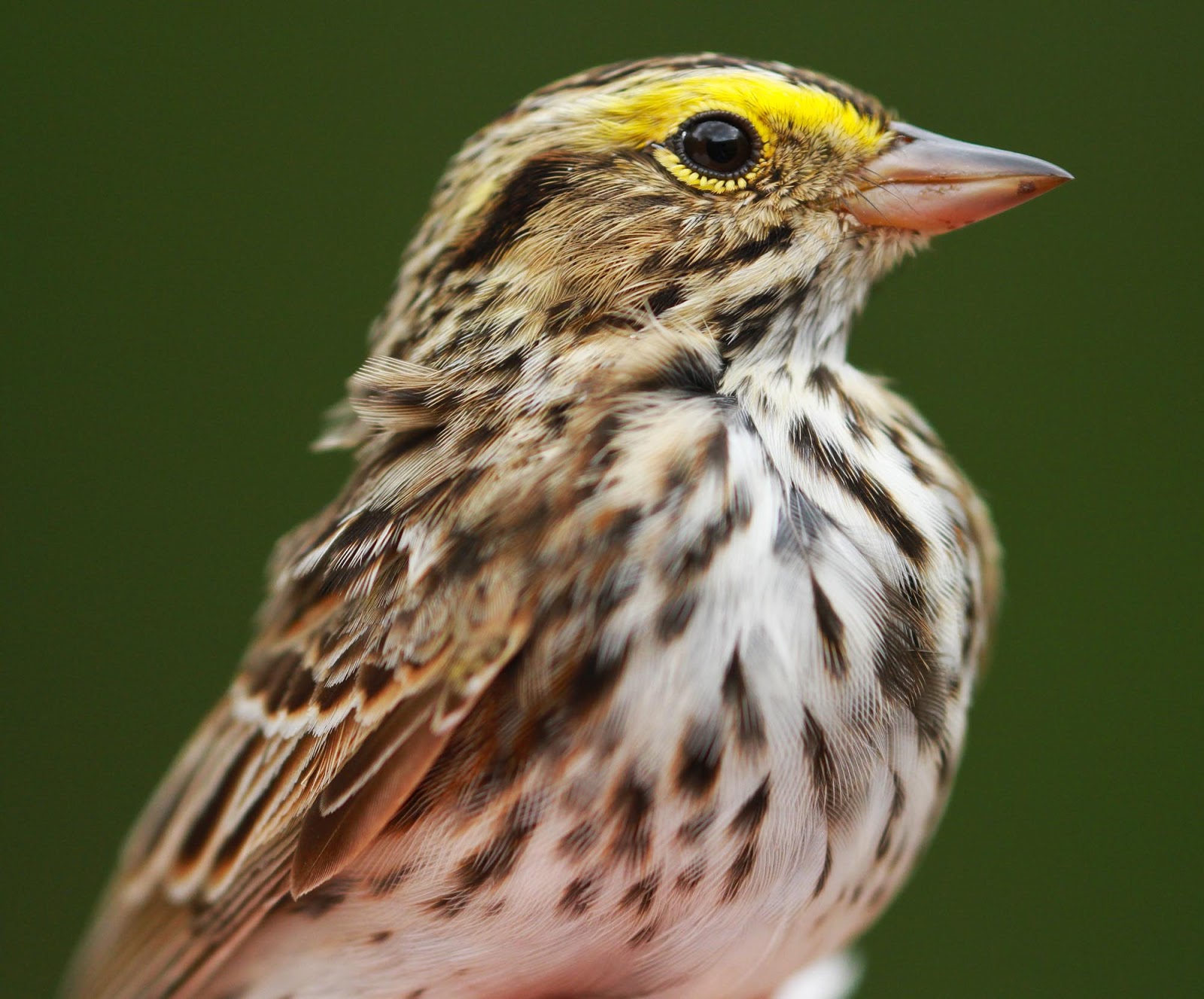
 We rarely capture Savannah Sparrows at Springbrook so this one was a treat to hold and see up close.

The yellow around and above the eye is very distinctive and identifies this sparrow.
 Crested Flycatchers like this one have just arrived from their wintering grounds in the south and will be nesting soon at Springbrook.

The crest seems to be raised and lowered constantly depending on the bird's mood at the moment.

Here it is raised and down below it is lowered.  
 All flycatchers have a hooked beak, to better grasp their flying insect prey that they catch in mid-air.
 Indigo Buntings have the most blue of all the birds I have ever seen.  They seem to define "blue" with different shades and degrees of intensity, but they are beautiful birds.

This is a male, and the females are very brown and camouflaged.  They will be setting up nest sites in Springbrook in the next few weeks.
Buntings are seed eaters, and have large, strong beaks that can bite hard, as many banders can verify.

The band can be seen on the right leg of this Indigo Bunting, as it is about to be released.

Warblers Everywhere at Springbrook

 The warblers were in full migration at Springbrook Nature Center yesterday during our bird banding event.  We caught 95 birds and 26 different species.

This was a rare chance to see these little warblers up close as well as high up in the trees.

This Magnolia Warbler was one of several we caught, banded, and released.
 This is the only Yellow Warbler we caught in the mist nets, but there were many singing and flying in the nature center. 

It has only taken nature about a week to catch up now that the long winter has finally let go.  There seemed to be lots of insects in the trees where these warblers were feeding
 This Mourning Warbler was a second year male, which can be told by the small and not completely black "bib" under the gray throat.  But still a very pretty bird that only passes through this area during spring and fall migration.
 This Chestnut Sided Warbler was one of several we caught in the nets.  This one is probably a female, as the "chestnut" on the sides does not extend down the side beyond the legs, and the crown patch is mottled greenish yellow, instead of solid bright yellow.

Banding these transient visitors is time consuming since each bird needs data recorded and complicated identification keys are needed to assure accuracy of ID, age and sex.
 This very handsome male Wilson's Warbler is an easy one to identify because of the very black crown on its head, offset with the bright yellow surrounding it.
Male Red Starts are easy to see flitting in the trees with their black bodies offset with the red patches on their wings, tails, and sides.

It is always a great pleasure to see the warblers return in the spring from their winters in Central and South America.

They will only be here for a few days so I plan on seeing as many as possible before they have continued their migration north.

For a few, like this Red Start, their journey may be finished, since some will nest right here in Springbrook.

Tuesday, May 7, 2013

Bloodroot, Hepatica, and Prairie Smoke Blooming

 Last week the Bloodroot was in self protect mode as late snow threatened it.  But today its protective leaf has opened up and the flower stretched out toward the sun.

Compare this picture with the previous post where the leaf is wrapped tightly around the unopened flower.


In the picture below some of the leaves still look a bit tentative, but not the flowers.  They know bright warm sun when they see it and feel it.  The third picture shows them pointed right at the sun, soaking up all the warmth.


 The Hepatica has just opened this morning with tiny little flowers.  It is still a little early for it, and maybe in a few days the flowers will be more normal size.
 The Prairie Smoke also started blooming today.  The flowers have just opened up, although, as can be seen, they never really do "open" up.

Prairie Smoke flowers have only a small opening for pollinators, forcing them to crawl inside for the nector waiting as in the picture below. 

The flower will eventually open up as the seeds extend out in a few weeks giving it the "smoky" look that it's name comes from.