It is late summer at Springbrook and at sunrise spiderwebs covered with dew drops were everywhere when I took these pictures two days ago. With the sun behind them the dragonflies are transparent and seem empty as can be seen below, waiting to warm up and start catching todays food.
The jewelweed at sunrise is covered with jewel-like dew drops, until the yellow jacket wasp sneaks in and eats the night's nector, knocking off the dew drops as she leaves. She can just be seen here at the bottom of the flower.
Thursday, August 16, 2012
Wednesday, August 8, 2012
Eastern Tailed Blue-A Tiny Butterfly
Eastern Tailed Blue butterflies are fairly common at Springbrook Nature Center, but not easy to see. With its wings folded, the butterfly is smaller than a US nickel (5cent) coin. They fly quickly and often are only a flash of blue in the air and then gone.
With wings folded, the male and female look identical, as can be seen with this mating pair. I took this picture last fall in Springbrook's west prairie.
The top wing color is quite different between males and females, as can be seen in these next two pictures.
This is the female to the left. I took this picture shortly after sunrise two days ago in the south prairie. It is rare to see them with their wings open like this. She was trying to warm up and had her wings facing directly at the sun. The females are supposed to be drab, but her colors seemed quite vivid to me.
The male has the blue color that flashes as he flies. I took this picture in the south prairie in the spring as it was feeding on this wild strawberry flower.
These tiny but pretty butterflies are almost always around on any hike at Springbrook during the summer. But you have to be looking for them, or they will flash past you and into the tree tops unseen.
With wings folded, the male and female look identical, as can be seen with this mating pair. I took this picture last fall in Springbrook's west prairie.
The top wing color is quite different between males and females, as can be seen in these next two pictures.
This is the female to the left. I took this picture shortly after sunrise two days ago in the south prairie. It is rare to see them with their wings open like this. She was trying to warm up and had her wings facing directly at the sun. The females are supposed to be drab, but her colors seemed quite vivid to me.
The male has the blue color that flashes as he flies. I took this picture in the south prairie in the spring as it was feeding on this wild strawberry flower.
These tiny but pretty butterflies are almost always around on any hike at Springbrook during the summer. But you have to be looking for them, or they will flash past you and into the tree tops unseen.
Tuesday, August 7, 2012
Field Bindweed A Beautiful Pest
Field bindweed is a vine that is blooming at Springbrook Nature Center now. Gardeners think it is a real pest plant, but it has a very pretty flower. Each flower only blooms for one day, and they open early in the morning, which is when I took these pictures yeaterday.
I think the flower looks like something Georgia O'Keeffe would have painted.
As I took the picture of the bumblebee leaving the flower below, I was surprised later to notice the green tree frog in the upper right of the picture. I didn't see it when I was there!
I think the flower looks like something Georgia O'Keeffe would have painted.
As I took the picture of the bumblebee leaving the flower below, I was surprised later to notice the green tree frog in the upper right of the picture. I didn't see it when I was there!
Monday, August 6, 2012
Green Heron Gathering
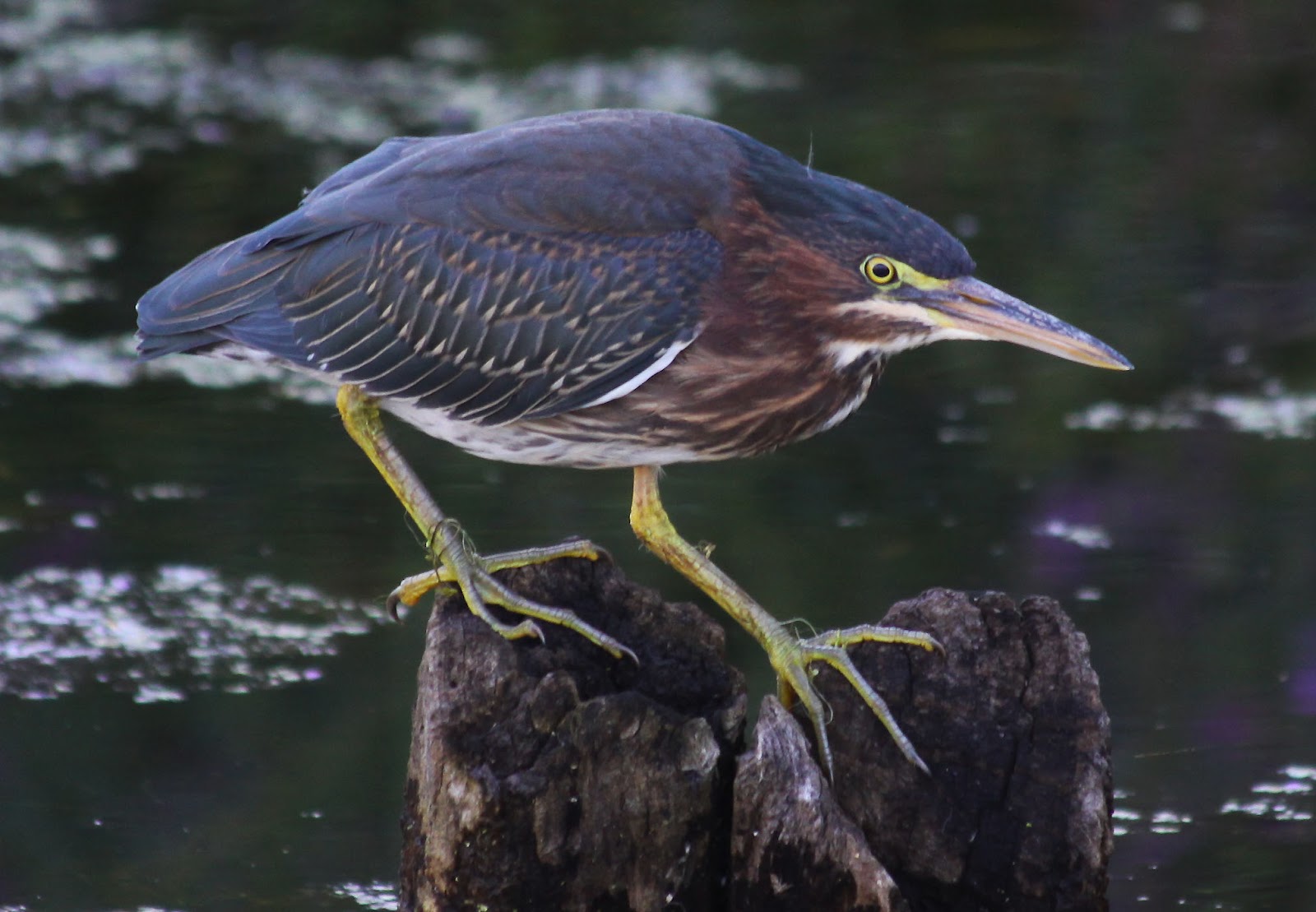
The Green Herons at Springbrook are getting ready to migrate already, which means they spend all their time out in the open on the edges of ponds looking for frogs or fish or anything else that moves.
I took these pictures this morning from Springbrook's long floating boardwalk. There were at least 25 of these herons hunting, preening, or noticing that a spot another heron had looked better, so let's fly over and check it out.
It seemed like they spent a lot of energy flying from one spot to another. There was almost always a couple of herons in the air checking out new locations.
In this picture their short stubby tail can be seen, and the crest on their head, which seems to be raised whenever something exciting/alarming enters the bird's mind.
In the picture below all the primary and secondary wing feathers can be seen and counted as the heron comes in for a landing. All the new feathers have molted in and it is ready to migrate.
I took these pictures this morning from Springbrook's long floating boardwalk. There were at least 25 of these herons hunting, preening, or noticing that a spot another heron had looked better, so let's fly over and check it out.
It seemed like they spent a lot of energy flying from one spot to another. There was almost always a couple of herons in the air checking out new locations.
In this picture their short stubby tail can be seen, and the crest on their head, which seems to be raised whenever something exciting/alarming enters the bird's mind.
In the picture below all the primary and secondary wing feathers can be seen and counted as the heron comes in for a landing. All the new feathers have molted in and it is ready to migrate.
Tuesday, July 10, 2012
Bald Cardinal
At bird banding this past Sunday at Springbrook we caught the sad looking female cardinal in the picture above. A very bad hair...ahh...feather day. We often capture cardinals with some of this "baldness" in the summer months, but this poor gal has it really bad.
There is some debate over what "it" is. Some feel it is normal molting, some think a skin mite, and others think a feather mite.
All I know for sure is that she can't get much more pathetic looking. And her ears are very noticable, the opening below and behind her eye. She should have her feathers back in a few weeks and look more like her old self in the picture to the left here.
Monday, July 2, 2012
Dragonfly Obelisks and Cannibals
Saturday was Springbrook's annual dragonfly count day. We saw many, and learned interesting things. This Twelve Spotted Skimmer was on the Beaver Pond trail pond. This is a male based on the white spots, which the females don't have.
Down below is a Blue Dasher sitting in the "obelisk" position. Some dragonflies point their abdoman directly at the sun to reduce their exposure and potential over-heating.
The Blue Dasher moves his body up until his shadow is the smallest it can get. The smaller
shadow means less exposure to the sun.
A different Blue Dasher wasn't watching close enough and this Eastern Pond Hawk dragonfly ate him for lunch. The wings of the Blue Dasher are in the middle and smaller than the Pond Hawk's, so size means survival in this dragonfly eat dragonfly world. Cannibalism is an everyday occurance in this habitat.
This beautiful Ebony Jewelwing Damselfly, along with several other species of damselflies, were also seen on the hike. This is a female, which is made known by the white spots on the end of the wings.
Dragonflies all hold their wings out flat all the time, while damselflies bring their wings together over their backs when at rest.
Down below is a Blue Dasher sitting in the "obelisk" position. Some dragonflies point their abdoman directly at the sun to reduce their exposure and potential over-heating.
The Blue Dasher moves his body up until his shadow is the smallest it can get. The smaller
shadow means less exposure to the sun.
A different Blue Dasher wasn't watching close enough and this Eastern Pond Hawk dragonfly ate him for lunch. The wings of the Blue Dasher are in the middle and smaller than the Pond Hawk's, so size means survival in this dragonfly eat dragonfly world. Cannibalism is an everyday occurance in this habitat.
This beautiful Ebony Jewelwing Damselfly, along with several other species of damselflies, were also seen on the hike. This is a female, which is made known by the white spots on the end of the wings.
Dragonflies all hold their wings out flat all the time, while damselflies bring their wings together over their backs when at rest.
Sunday, July 1, 2012
Dobsonfly Pupae Becomes Adult
Above is the picture I posted two weeks ago just after the Hellgramite larvae shed its skin into this interesting pupae. Nine days later I photographed it again the night before it emerged as an adult Dobsonfly.
The color changes in the wings, legs, eyes, jaws, head and thorax. The wings especially will grow enormously after it emerges, as can be seen in the pictures below.
If this picture is compared to the close up of the head in the previous post there are a lot of color changes. The skin of the pupae seems to be separating from the new skin underneath of the adult Dobsonfly around the eyes and on the back of the head.
Even at this point the pupae was very active and trying to bite with its jaws. It was difficult to get it to sit still long enough for the pictures.
Here is the cast off pupal skin I discovered the next morning. It is entirely intact with only a split on the back where the Dobsonfly emerged. Except for the vacant head and eyes, it looks alive, but a bit transparent.
Here is the adult female Dobsonfly that emerged from the pupae. She is a little over 4 inches long and very agressive and defensive. At night after dark she was flying strongly around the room.
The day after I took this picture someone brought a male into the nature center. Its photo is below. The big difference between the males and females is very obvious. The pincers on the male are huge, and he can use them effectively, drawing blood from a finger that is not protected when positioning him for a photo shoot!
Here is a last shot of the two heads showing the difference. Notice also the two extra eyes in the middle of the top of the head that face slghtly backwards. I had some interesting reflection from these eyes with the flash from the camera. I will put those pictures up in a future post.
Subscribe to:
Posts (Atom)