I'm finding many June "Bug" (beetle) larvae in my wood chips. To the eye they look like normal white grubs with orange heads and legs. But the camera flash makes their skin transparent, and the design of their breathing holes, or spiracles, is revealed.
Look at the incredible network of tubes that take the air in and exhale carbon dioxide. Probably not a major contributor to global warming, but fascinating to see up close.
Saturday, June 16, 2012
Thursday, June 14, 2012
Flowers and Froglets
On the edges of Springbrook's wetlands the wild Iris is in full bloom. The splash of color mixed in with the new greens of summer adds to the scenery on the trails.
And at the same time the Iris is blooming, the male green frogs begin to call near the base of the plants, staking out territories, trying to attract females into their space.
The Green Frogs are all along the long floating boardwalk at Springbrook, and easy to see. I took this picture from the boardwalk on Friday.
This is a male, and is distinguished from the females by the eardrum being bigger than its eye. The female's ear drum is smaller.
At the same time the males are setting up territories, last year's tadpoles are metamorphosing into frogs. They have legs and breath air, but still have a long tail. The tail on this one near the boardwalk goes under the little feather at the far left of the picture.
Wednesday, June 13, 2012
Yellow Slime Mold That Isn't
Yellow Slime Mold has been showing up in the woodchips and dead logs at Springbrook lately. If you see it shortly after it "erupts" it looks like a plate of macaroni and cheese. Really!
But it turns out that it is not a slime mold at all, or even in the fungi family. Science has reclassified it as an Amoebozoa. Kind of like the very old scary movie "The Blob." But this one is real, and it eats micro-organisms in dead plant material, helping with decomposition.
Scientists have determined that what appears to be a "mold" like organism is actually thousands of protozoa like amoebas that behave very differently when they come together. Under the surface they first form these filiment-like "gatherings" and within an hour or so they multiply and sort of bubble up to the surface, as you can see in the next picture.
Within another hour this "blob" grows and becomes shiny and wet. It may get big enough to cover a dinner plate, and 2 or 3 inches high on the top of the surface of the woodchips.
It begins to fade after a few hours, and by morning it has lost its color, and is either some tan filiments, or a faded brown blob that must be dead amoebas, because it stays for days until washed away, as can be seen in the pictures below.
I think this picture is remaining amoebas escaping back into the woodchips.
Writing this blog gets me to double check my facts, and also learn new things. For many years I have been telling folks about slime molds, thinking this was one.
What is great about science is that it keeps checking on itself, and when a mistake is discovered, it corrects itself, and everyone moves on with the new knowledge. Wouldn't it be great if that worked for other life issues as easily?
This Yellow Slime Mold that isn't is very interesting, and I hope some time to look at it under a microscope. Maybe I can get some pictures and post them here.
Tuesday, June 12, 2012
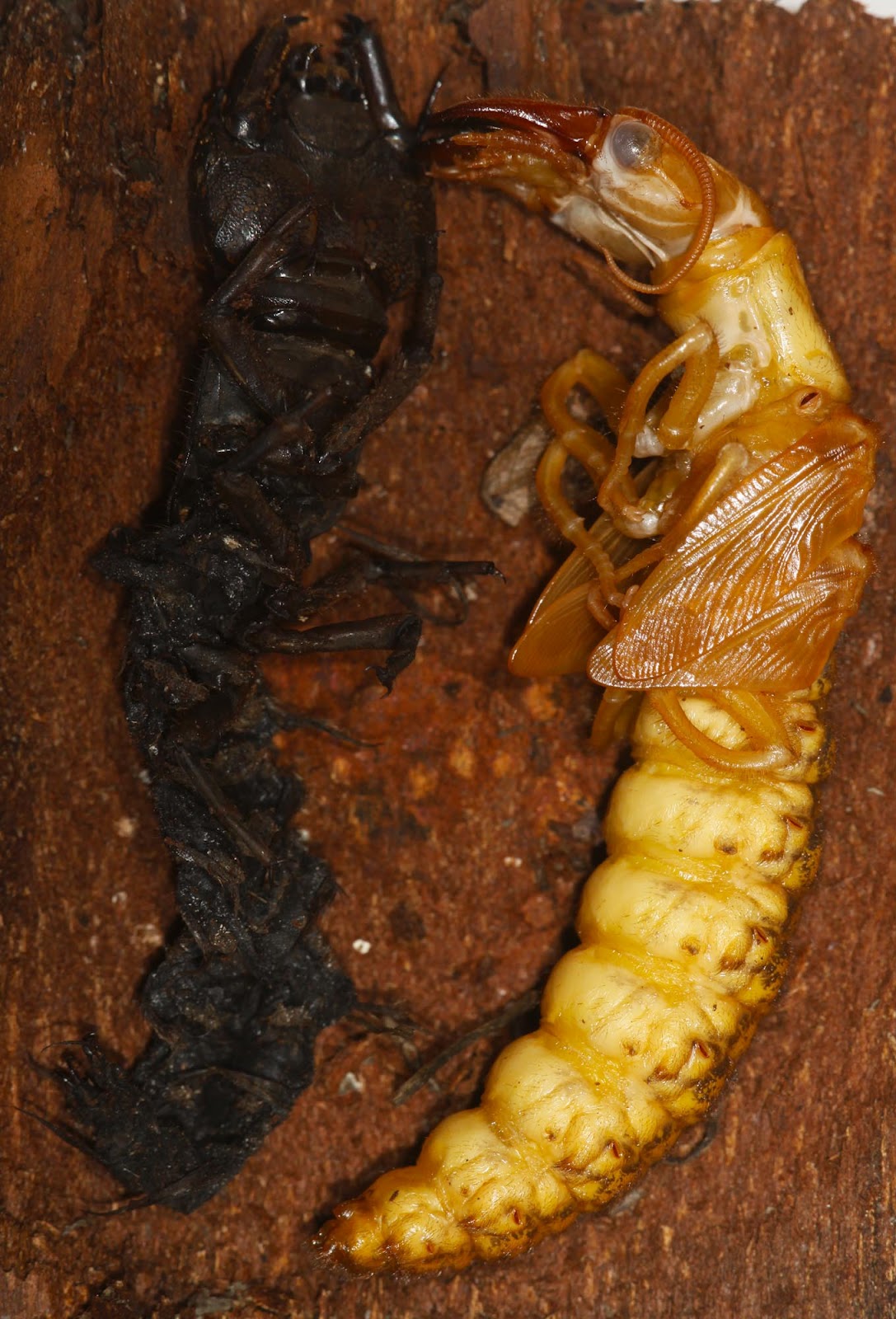
Hellgramite Wandering Equals Dobsonfly Pupae
Hellgramites are one of the largest and most agressive aquatic insects around. They are fierce predators in fresh water streams, rivers, and ponds here in Minnesota. They live for 3 or 4 years under water getting bigger and developing very bad attitudes.
But after their years in the water, about mid May, the older ones leave the water and begin to wander looking for a safe place to hide while changing into an adult insect.
The one in this picture is 4 inches long and was hard to get to sit still for a photograph. They move constantly, and bite hard when picked up. This one was found wandering across a gas station parking lot. It crawled around the cage I put it in for a week before it curled up and lay quietly for another week under a large piece of bark on some wood chips.
It has six true legs but appendages on each segment of it's abdoman look like additional legs. They are useless as legs, though. But notice the 4 "claws" on the tail end. It uses these to thrust itself backward very quickly, much like a crayfish.
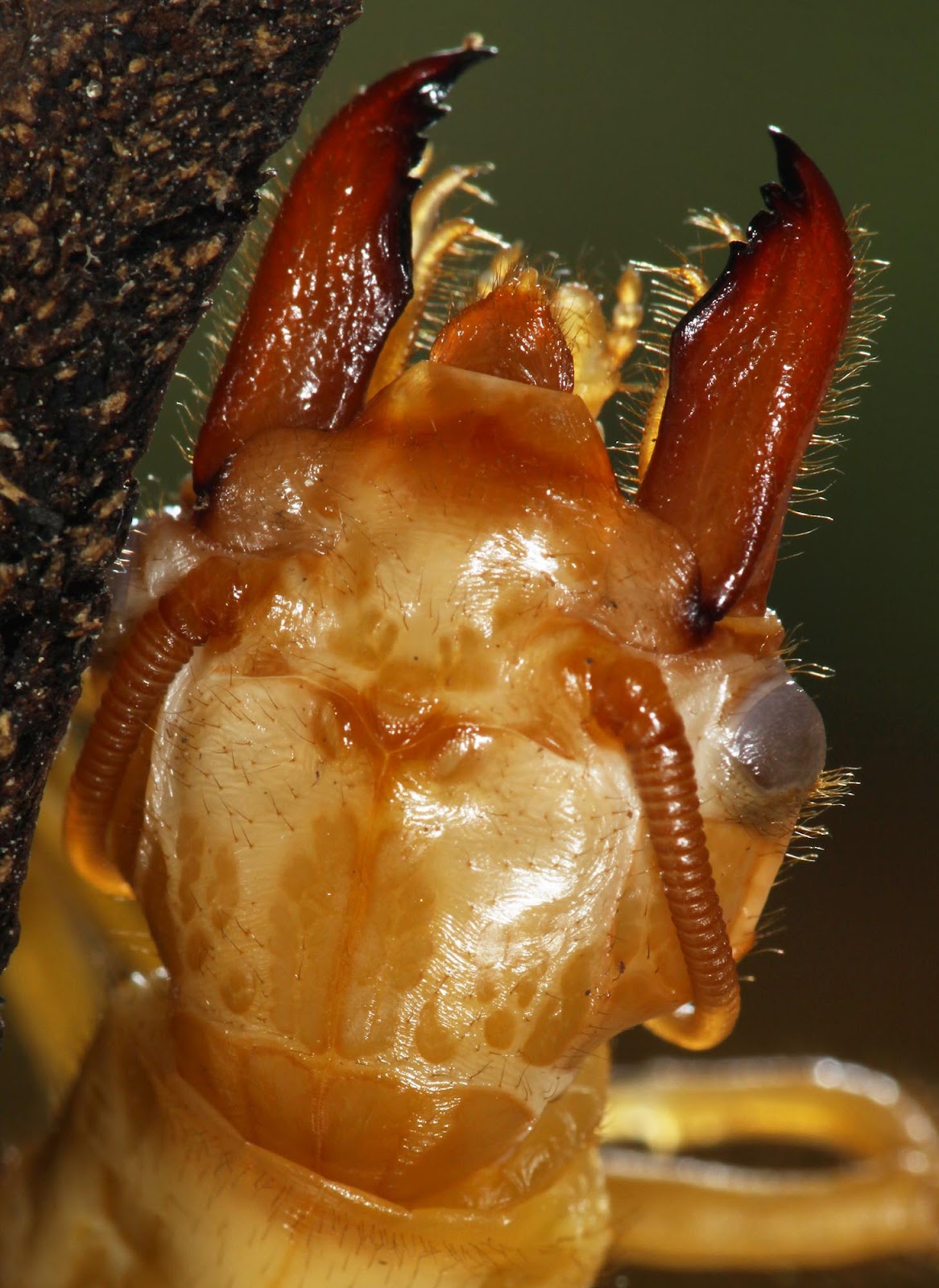
Here you can see it's large and powerful jaws.
Last Friday night, after a week of quiet, it shed the black/brown larval skin and entered the pupae stage of its life.
I think it looks like a baby dragon about to emerge as an adult. You can see it already has the wings, the antennae, and the long legs that will be promenent as an adult Dobsonfly. I will post pictures of that after it emerges.
It twists and turns as if it is having dreams of an active adult life. When I took these pictures it used its jaw and body to try to push itself back under cover. It could move quickly.
And its jaws still work and look pretty mean as can be seen in the bottom picture.
This is a very cool insect that looks very different in its separate life stages. As you will see in a future post, the adult is not yellow, so why this color is present in the pupae is a mystery, especially after the larvae was so color blended with its habitat.
Saturday, May 26, 2012
Birds/Warblers and Butterflies at Springbrook
This seems to be the year for butterflies at Springbrook. I have already seen many more numbers and species than usual. I saw three individuals of this Ohio Buckeye Butterfly yesterday. This is the first time in 30 years I have seen this butterfly at Springbrook. The Red Spotted Purple butterfly down below was sitting in the access trail/road near the railroad tracks. It was sipping water/minerals from beneath the rocks, so sat still with its wings open, an unusual sight.
This butterfly is usually flying fast in and around the edges of wooded areas, and is normally hard to get close to. This butterfly is closely related to the White Admiral in the post I made earlier this week. The two butterflies can interbreed, making for some odd color combinations in the next generation.
This "after second year" male Mourning Warbler is one we caught at last Sunday's bird banding at Springbrook. This is one of the late migrants still flying north to find a place to nest for the summer.This Chestnut Sided Warbler male is one of the prettier warblers we caught in the mist nets last Sunday. After being measured and weighed, along with having a band placed on his leg, he was released to continue his journey north to find a nesting area.
Firefly Larvae and Pupae Bioluminescence
A few days ago when searching through a rotting stump I found these Firefly larvae and two pupae. I took this 4 second exposure to capture the bioluminescence in their abdomens. Any day the adult fireflies, which are a kind of soft winged beetle, will be emerging and flying the low areas adding their allure to late evening hikes at Springbrook and other natural areas.
The chemical/pigment luciferin combines with oxygen to cause the glowing "light" in fireflies. An enzyme called luciferase speeds up the reaction to make them even brighter. Nature and science combine in ways that make wonderful viewing for us.
Wednesday, May 23, 2012
White Admiral Butterfly Life Cycle
Two weeks ago I was leading a group of 2nd graders around the Beaver Pond trail at Springbrook Nature Center. We were looking for examples of life cycles in nature. One of the students noticed this very odd caterpillar feeding on a wild cherry tree leaf. It was a White Admiral butterfly caterpillar. These Caterpillars mimic a bird dropping to not get eaten. Two days later it attached itself to the cherry twig stem and hung up side down preparing to metomorphose into it's chrysalis. This is the part of it's life cycle where it stays quiet while changing into a butterfly, or the adult portion of its life.
It hung like this for less than 24 hours before its skin split and the new chrysalis underneath was revealed.
Notice the spiracles, or breathing openings, one on each segment of its body. they are little tiny dark "holes" in the center of each segment.
I took this picture within an hour after it shed it's caterpillar skin. Notice that you can already see the veins in the wings, and the antennae running along the front edge of the wing.
Less than 24 hours before photo was taken this was a caterpillar walking up the leaf on the tree!
It still is trying to look like a bird dropping so nothing will eat it. It also has this very odd disc sticking out of its back. Somehow the disc must make it look less like something good to eat, because I don't believe it will be of any use to the future butterfly.
Seven days later the skin over the wings has hardened and you can begin to see butterfly forming inside the transparent skin.
By the 8th day as a chrysalis the color of the scales on the wings can be seen through the skin. With each hour the colors are more vivid now.
The butterfly was ready to emerge at this point. I waited up until after midnight to try to catch it breaking out of the chrysalis, but finally gave up.
It must have emerged shortly after I left it, since the chrysalis was empty at 6:30 AM the next morning. The butterfly was a few inches away on the twig, with wings hardened after several hours of drying
The White Admiral is a good example that you do not have to go to the tropics to see beautiful, colorful butterflies. They exist right here in Minnesota, and this is one of the most colorful.
Here it is next to the now empty chrysalis.
These pretty butterflys are slightly smaller than Monarch butterflies, and are found in wooded areas where they fly very fast zig-zag patterns amongst the branches of the trees. They are at Springbrook right now near the park entrance. But you need quick eyes to see them.
Subscribe to:
Posts (Atom)