Monday, May 20, 2013

Spring Birds At Springbrook-Pileated to Indigo Bunting

At Springbrook's birdbanding yesterday we did not only catch warblers, as exciting as they are.  We also caught other fascinating birds and I was able to photograph some, like this female Pileated Woodpecker.  In males, the red on the head goes all the way to the beak, along with other differences.

She had a large scaley broodpatch, so she has a nest somewhere in Springbrook.
 This Red Eyed Vireo is certainly demonstrating its red eye in this photo, along with the hooked beak of all vireos.  Glad they don't bite like chickadees.

These vireos will be nesting at Springbrook very soon.
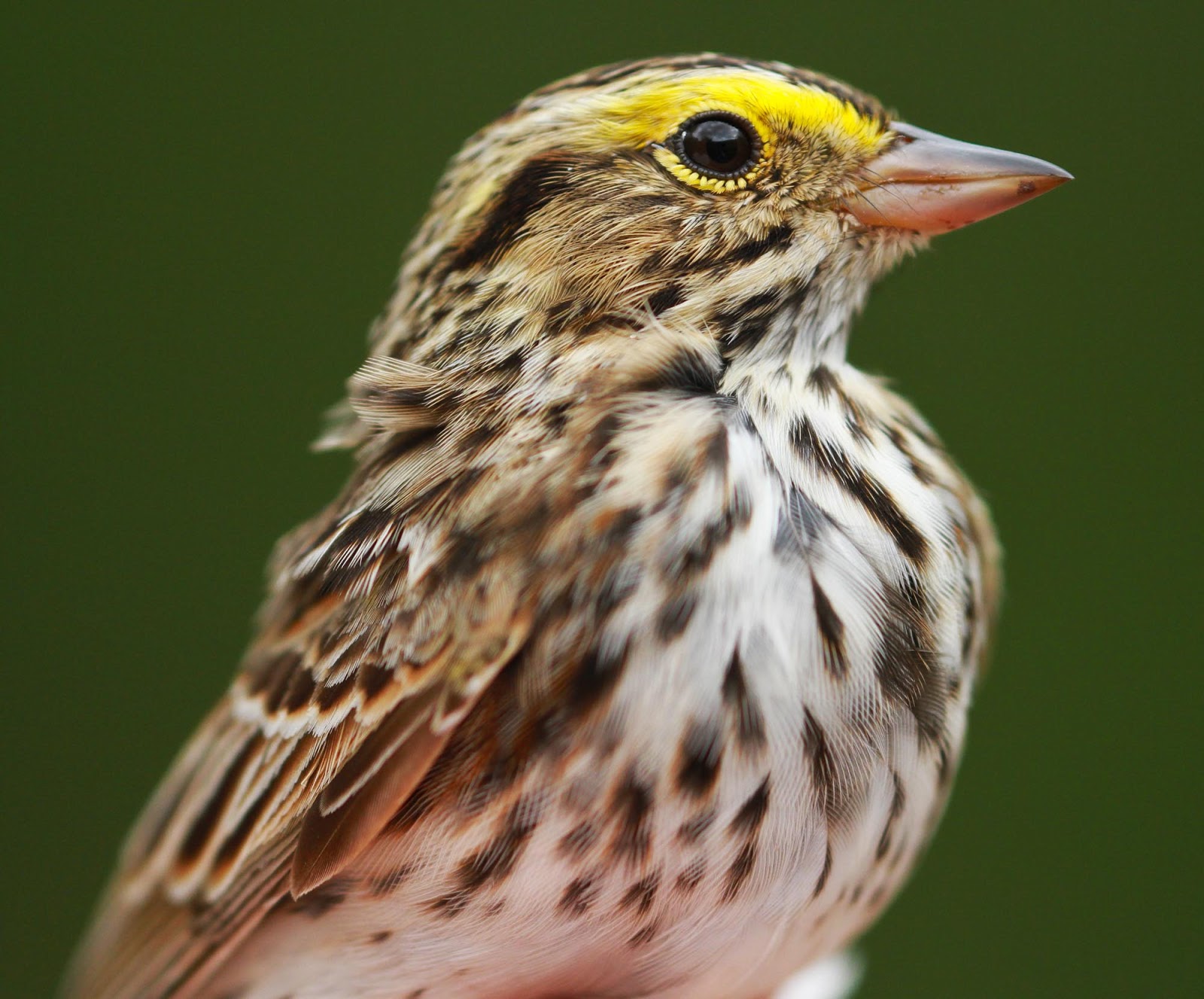
 We rarely capture Savannah Sparrows at Springbrook so this one was a treat to hold and see up close.

The yellow around and above the eye is very distinctive and identifies this sparrow.
 Crested Flycatchers like this one have just arrived from their wintering grounds in the south and will be nesting soon at Springbrook.

The crest seems to be raised and lowered constantly depending on the bird's mood at the moment.

Here it is raised and down below it is lowered.  
 All flycatchers have a hooked beak, to better grasp their flying insect prey that they catch in mid-air.
 Indigo Buntings have the most blue of all the birds I have ever seen.  They seem to define "blue" with different shades and degrees of intensity, but they are beautiful birds.

This is a male, and the females are very brown and camouflaged.  They will be setting up nest sites in Springbrook in the next few weeks.
Buntings are seed eaters, and have large, strong beaks that can bite hard, as many banders can verify.

The band can be seen on the right leg of this Indigo Bunting, as it is about to be released.

Warblers Everywhere at Springbrook

 The warblers were in full migration at Springbrook Nature Center yesterday during our bird banding event.  We caught 95 birds and 26 different species.

This was a rare chance to see these little warblers up close as well as high up in the trees.

This Magnolia Warbler was one of several we caught, banded, and released.
 This is the only Yellow Warbler we caught in the mist nets, but there were many singing and flying in the nature center. 

It has only taken nature about a week to catch up now that the long winter has finally let go.  There seemed to be lots of insects in the trees where these warblers were feeding
 This Mourning Warbler was a second year male, which can be told by the small and not completely black "bib" under the gray throat.  But still a very pretty bird that only passes through this area during spring and fall migration.
 This Chestnut Sided Warbler was one of several we caught in the nets.  This one is probably a female, as the "chestnut" on the sides does not extend down the side beyond the legs, and the crown patch is mottled greenish yellow, instead of solid bright yellow.

Banding these transient visitors is time consuming since each bird needs data recorded and complicated identification keys are needed to assure accuracy of ID, age and sex.
 This very handsome male Wilson's Warbler is an easy one to identify because of the very black crown on its head, offset with the bright yellow surrounding it.
Male Red Starts are easy to see flitting in the trees with their black bodies offset with the red patches on their wings, tails, and sides.

It is always a great pleasure to see the warblers return in the spring from their winters in Central and South America.

They will only be here for a few days so I plan on seeing as many as possible before they have continued their migration north.

For a few, like this Red Start, their journey may be finished, since some will nest right here in Springbrook.

Tuesday, May 7, 2013

Bloodroot, Hepatica, and Prairie Smoke Blooming

 Last week the Bloodroot was in self protect mode as late snow threatened it.  But today its protective leaf has opened up and the flower stretched out toward the sun.

Compare this picture with the previous post where the leaf is wrapped tightly around the unopened flower.


In the picture below some of the leaves still look a bit tentative, but not the flowers.  They know bright warm sun when they see it and feel it.  The third picture shows them pointed right at the sun, soaking up all the warmth.


 The Hepatica has just opened this morning with tiny little flowers.  It is still a little early for it, and maybe in a few days the flowers will be more normal size.
 The Prairie Smoke also started blooming today.  The flowers have just opened up, although, as can be seen, they never really do "open" up.

Prairie Smoke flowers have only a small opening for pollinators, forcing them to crawl inside for the nector waiting as in the picture below. 

The flower will eventually open up as the seeds extend out in a few weeks giving it the "smoky" look that it's name comes from.

Monday, May 6, 2013

Solitary Sandpiper at Springbrook--Barred Owl Eats Sparrow

 At yesterday's birdbanding at Springbrook Nature Center a Solitary Sandpiper flew into one of the mist nets.  The first one of these we have captured in over 25 years.  It was banded and released quickly but not before we had a good chance to see it up close. 
A beak longer than its head is an identifyer for this bird, as well as the very white eye ring.
The white eye ring is very obvious here.

We caught about 95 birds yesterday, many were migrating warblers and other migrants, including the sandpiper.

We caught several migrating White Throated Sparrows, but one we didn't catch was caught by the Barred Owl, who made a quick breakfast of it, swallowing it whole as can be seen below.  Yum!


Friday, May 3, 2013

Bloodroot in May Snowstorm

 This morning in the blowing snow the large enveloping leaf of the bloodroot looked exactly like the protective cover that it is for the single flower of each plant. 

This unusual May snowstorm is the reason this early spring wildflower is protected in this way.

The more adventurous flower below was ready to open but stayed closed as the snow flakes built up on its petals.

I think the Bloodroot and the rest of us are all ready for more normal spring weather!


Sunday, April 28, 2013

Pasque Flowers Emerge First

 With the first warm weather these past couple of days, the Pasque Flowers emerged from this very long winter very quickly.  I took these pictures this morning. 

The first flowers of spring are showy and beautiful.

Saturday, April 20, 2013

Spring? at Springbrook 2013


 Spring migrants have arrived in full force at Springbrook, but they all look a little dazed. There were over 40 Fox Sparrows at a time at the feeders in the past few days scratching the snow back to find seeds near the soil. Usually we might see 6 or 8.

Our extended snowy season this year is making it difficult for many of the migrant birds.  Swallows and flycatchers that depend on insects are having a hard time finding enough to eat.
 This Hermit Thrush was turning leaves over along the edge of the windows finding worms.  There were at least 5 other Hermit Thrushes doing the same thing.
Many people have seen the flocks of Robins flying everywhere.  Some of the Robins are getting innovative as they cannot find open ground to search for worms.

This one spied the suet feeder and decided to try it out.  I think he watched the woodpeckers and thought it looked easy.
 But he discovered his toes are not made for hanging on to the sides of anything, and his body is heavy to hold up.

But after many tries he finally got the "hang" of it, as can be seen below, and has stayed close to the suet feeder for over a week.
He will often fly onto the feeder knocking it around, then fly down to the ground and eat the bits of suet that have fallen off.
 A Barred Owl has noticed the hundreds of birds flocking around the feeders, and watches them closely.


When there are many birds on the ground and close to the windows he will fly at them as can be seen below.  I think his plan or hope is that one will fly into the windows and be stuned for a moment.  Long enough for him to get a meal.  I have not seen it work yet.  But it must have worked once, as he keeps trying.

Many deer come to the feeders looking for food.  They have been living off of fat for many months now and need new green food desperately.  The late snow is slowing that process down.  Within a couple of weeks the does will be having fawns, and will need fresh food.

Forgive this anthropomorphism, but I asked this deer what she thought of this year's spring weather, and the picture below was her response.