On the trails at Springbrook this morning spring was intensely present.
The Yellow Rumped Warblers were feeding in the wetlands on the midges that hatched yesterday.
These little warblers are often the first to return, and this year have been here for two weeks with very few other warblers showing up.
The cold weather has kept them close to the ground looking for food, so they are easy to see.
You can see in the picture below why they are called "Yellow Rumped" warblers.
Looking for bugs in wetlands and even eating from suet feeders, as I have seen one at my feeders doing, shows how well adapted these early warblers are to the chances of early spring weather in Minnesota.
They will travel to northern Minnesota to find a place to nest.
The Cedar Waxwings were eating the berries of the invasive European Buckthorn this morning. The berries are a powerful emitic, so the seeds will be pooped out right away, planting more buckthorn trees!
This male Red Winged Blackbird is showing the females how agressive he can be defending his territory. What interested me was the band on his right leg (on the left here). I photographed three male Redwings with bands this morning-but didn't notice the bands until I was looking at the pictures.
Below is one of the midge flys that hatched yesterday, caught in one of the first spider webs of the year. The sun had just hit this web, turning the frost to dew almost instantly.
The emerging leaves on this Gray Dogwood twig were covered with frost as the sun rose this morning. You can see which side faced east, as the frost changed to dew drops as the sun's warmth touched the twig.
The tiny lichen called British Soldiers is growing its red fruiting caps now. Look for it on dead logs in open areas. I found these in Springbrook's oak savannah.
Sunday, April 24, 2011
Friday, April 15, 2011
Turkey's Gobbling
Wild Turkeys are actively in their mating season at Springbrook now. I took these pictures yesterday looking into the bird feeding area.
This is the first year males have been present in the park, and they are really putting on a show, gobbling and strutting in front of the windows while the hens are feeding.
I believe they see their reflection and think it is another male, so they try to out-perform the reflection, getting right up close to the window so the hens will have an easy time comparing.
I have only seen two males, and only one gobbling and strutting. But they can't be putting on displays all the time, and this is what they look like when a bit more relaxed. Notice how much shorter and smaller the "snood" is here. The "snood" is the fleshy red projection on top of and behind the beak.
Also notice the short "beard" projecting from the turkey's chest. the short length suggests this turkey is young, probably a "Jake," just one or two year's old. Maybe that is why he is at Springbrook, where he does not have to compete with older, more established males in other areas. Older Tom turkeys have beards over one foot long.
In this picture the "snood" is a little bigger, and the beard can be seen better.
The bright colors on the head of the males are what tells the difference from the females. Other wise they look pretty similar, except that most female turkey's also lack the beard. About one in ten females do have short "beards," which is why hunting regulations for turkeys allow shooting of "bearded" turkeys. That way very few females are taken, and reproduction is high the next year.
Here is a female or hen turkey for comparrison. This one is sitting on a fence rail by the bird feeders. Turkeys can fly very well, and roost in the top of tall trees at night.
The hens seem to ignore the performance of the males, but I am pretty sure they are watching, and that Springbrook will have baby turkeys by the end of May.
This is the first year males have been present in the park, and they are really putting on a show, gobbling and strutting in front of the windows while the hens are feeding.
I believe they see their reflection and think it is another male, so they try to out-perform the reflection, getting right up close to the window so the hens will have an easy time comparing.
I have only seen two males, and only one gobbling and strutting. But they can't be putting on displays all the time, and this is what they look like when a bit more relaxed. Notice how much shorter and smaller the "snood" is here. The "snood" is the fleshy red projection on top of and behind the beak.
Also notice the short "beard" projecting from the turkey's chest. the short length suggests this turkey is young, probably a "Jake," just one or two year's old. Maybe that is why he is at Springbrook, where he does not have to compete with older, more established males in other areas. Older Tom turkeys have beards over one foot long.
In this picture the "snood" is a little bigger, and the beard can be seen better.
The bright colors on the head of the males are what tells the difference from the females. Other wise they look pretty similar, except that most female turkey's also lack the beard. About one in ten females do have short "beards," which is why hunting regulations for turkeys allow shooting of "bearded" turkeys. That way very few females are taken, and reproduction is high the next year.
Here is a female or hen turkey for comparrison. This one is sitting on a fence rail by the bird feeders. Turkeys can fly very well, and roost in the top of tall trees at night.
The hens seem to ignore the performance of the males, but I am pretty sure they are watching, and that Springbrook will have baby turkeys by the end of May.
Tuesday, April 12, 2011
Wood Frogs Fighting and Calling
Wood Frogs are usually the first to start calling every spring, often before the snow and ice are gone. They often call for only one or two days, since they call and lay their eggs in vernal pools--bodies of water that dry up usually by late spring.
They were calling at Springbrook yesterday, and I was only able to get these poor quality photos. The pool is big this year--because of the big snow melt.
The males set up small territories in the middle of the pool. They call while floating on top of the open water, and they fight for the few open spaces. In the top photo you can see one approaching the closer one. The next picture I call a "muddle." Three or more males converge and "wrestle" underwater to determine who gets the spot. This lasts for five or ten seconds. And then five or ten minutes later it happens again.
Wood Frogs inflate air sacs on the sides of their upper chest area and expel the air to make their short croaking--barking calls. The easiest way to find them is to look for the ripples in the water that the frog makes when making the call.
You can see the air sacs on the lower photo--sorry for the quality.
These frogs were about 75 feet away so even with a 500 mm lens they were tiny in the view finder, and these pictures are cropped out of the original much bigger picture.
Still, it is always a great pleasure to hear the wood frogs the once every three or four years I am able to catch their calls on the one day they are there.
They were calling at Springbrook yesterday, and I was only able to get these poor quality photos. The pool is big this year--because of the big snow melt.
The males set up small territories in the middle of the pool. They call while floating on top of the open water, and they fight for the few open spaces. In the top photo you can see one approaching the closer one. The next picture I call a "muddle." Three or more males converge and "wrestle" underwater to determine who gets the spot. This lasts for five or ten seconds. And then five or ten minutes later it happens again.
Wood Frogs inflate air sacs on the sides of their upper chest area and expel the air to make their short croaking--barking calls. The easiest way to find them is to look for the ripples in the water that the frog makes when making the call.
You can see the air sacs on the lower photo--sorry for the quality.
These frogs were about 75 feet away so even with a 500 mm lens they were tiny in the view finder, and these pictures are cropped out of the original much bigger picture.
Still, it is always a great pleasure to hear the wood frogs the once every three or four years I am able to catch their calls on the one day they are there.
Wednesday, April 6, 2011
Turtle on Ice
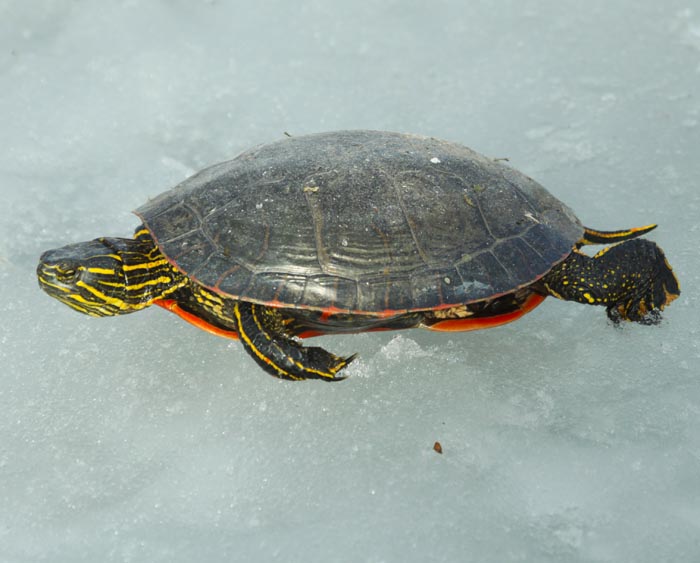
While hiking Springbrook's main trail yesterday to see signs of spring, this was the strangest and most surprising one. A painted turtle slowly walking across the ice of the large pond area. Never seen this before. The temperature was around 50 at 5 PM, but there was no way this turtle was going to find shelter before the temp dropped below freezing.
How do supposedly "cold blooded" animals do this? Animals that are not able to raise their body temperature except by sitting in the sun.
Somehow this turtle was creating warm enough muscle tissue to keep moving across the ice.
Here is the turtle and the pond with six inches of ice left, and the only open water a few inches at the edge of the cat tails.
This turtle looked like fox or mink food to me. A mink crossed the trail in front of me and entered this wetland just a few minutes after I saw this turtle.
Hope the turtle knew what it was doing and we see it this summer swimming in the wetland.
How do supposedly "cold blooded" animals do this? Animals that are not able to raise their body temperature except by sitting in the sun.
Somehow this turtle was creating warm enough muscle tissue to keep moving across the ice.
Here is the turtle and the pond with six inches of ice left, and the only open water a few inches at the edge of the cat tails.
This turtle looked like fox or mink food to me. A mink crossed the trail in front of me and entered this wetland just a few minutes after I saw this turtle.
Hope the turtle knew what it was doing and we see it this summer swimming in the wetland.
Thursday, March 24, 2011
Robin-Early Bird Gets Worm
In the middle of yesterday's snowstorm this Robin was wondering what happened to the nice spring weather. At least that is what I imagined he was thinking.
The Robins seem to have arrived en mass a little early this year, but last week almost all the early migrators arrived within a few days. Red Winged Blackbirds, Sand Hill Cranes, Great Blue Herons, Grackles, Fox Sparrows, Wood Cocks, are just a few of the ones I saw.
But this snow and cold weather will test some survival skills.
I don't normally consider birds able to make expressions with their fixed beaks, but this Robin seemed to be telling me what he thought of this weather in this picture.
The first and strongest migrants that arrive get first pick of the best territories, so this Robin is willing to put up with some cold weather for a choice space.
Even though the Robins are here, I was very surprised to see this earth worm lying in the snow, slowly moving, in the middle of the trail at Springbrook on Tuesday. While it doesn't look injured, I can only imagine that some bird, probably a Robin, dropped it while flying to a perch. Who knows?
But this is a case where I think the early bird-in this case the early migrating Robins, really did get the worm! Or at least tried and dropped it later.
The Robins seem to have arrived en mass a little early this year, but last week almost all the early migrators arrived within a few days. Red Winged Blackbirds, Sand Hill Cranes, Great Blue Herons, Grackles, Fox Sparrows, Wood Cocks, are just a few of the ones I saw.
But this snow and cold weather will test some survival skills.
I don't normally consider birds able to make expressions with their fixed beaks, but this Robin seemed to be telling me what he thought of this weather in this picture.
The first and strongest migrants that arrive get first pick of the best territories, so this Robin is willing to put up with some cold weather for a choice space.
Even though the Robins are here, I was very surprised to see this earth worm lying in the snow, slowly moving, in the middle of the trail at Springbrook on Tuesday. While it doesn't look injured, I can only imagine that some bird, probably a Robin, dropped it while flying to a perch. Who knows?
But this is a case where I think the early bird-in this case the early migrating Robins, really did get the worm! Or at least tried and dropped it later.
Sunday, March 20, 2011
Pileated Woodpeckers Create Tree Mulch
Pileated Woodpeckers are the largest woodpeckers in Minnesota--really in North America, unless the Ivory Bill still actually exists. Pileateds are the size of a crow and are impressive and beautiful birds. They are not uncommon, but they are shy and keep from sight as much as possible. This male is one of the pair that live at Springbrook. I was able to take these pictures a couple of days ago at the bird feeder area at the nature center. The female kept out of sight behind the tree. The male is identified by the red extending back from the beak. In the female this line is black.
In this picture you can see how woodpeckers use their stiff tail feathers as a prop to hold their body away from the tree while looking for food.
The red crest is very bold on these birds, and is raised or lowered depending on the birds level of excitement.
As you can see in the pictures below this pair of woodpeckers have ravaged a number of trees during the winter while looking for the insect larvae inside that provide them with enough nourishment to survive snowy and cold winters.
This tree was shredded inside and out looking for the grubs that were living inside. This is a common sign that Pileated woodpeckers live in an area. I took both of these pictures in the last few days at Springbrook on the trails. From the trails you can see the evidence left by the Pileateds all along the wooded areas. Piles of fresh wood mulch on the ground at the base of a tree is proof that these woodpeckers are visitors to the area.
This cavity was over four feet long with the obvious huge pile of wood chips on the ground in front of it. Another cavity just as long was immediately above this one, but had been done at least a year ago.
If I could just get these woodpeckers to make mulch for my gardens like this! But I hope the trees in my yard don't have this many insects living inside.
In this picture you can see how woodpeckers use their stiff tail feathers as a prop to hold their body away from the tree while looking for food.
The red crest is very bold on these birds, and is raised or lowered depending on the birds level of excitement.
As you can see in the pictures below this pair of woodpeckers have ravaged a number of trees during the winter while looking for the insect larvae inside that provide them with enough nourishment to survive snowy and cold winters.
This tree was shredded inside and out looking for the grubs that were living inside. This is a common sign that Pileated woodpeckers live in an area. I took both of these pictures in the last few days at Springbrook on the trails. From the trails you can see the evidence left by the Pileateds all along the wooded areas. Piles of fresh wood mulch on the ground at the base of a tree is proof that these woodpeckers are visitors to the area.
This cavity was over four feet long with the obvious huge pile of wood chips on the ground in front of it. Another cavity just as long was immediately above this one, but had been done at least a year ago.
If I could just get these woodpeckers to make mulch for my gardens like this! But I hope the trees in my yard don't have this many insects living inside.
Sunday, March 6, 2011
Hawk and Owl Eye Protection-Nictitating Membranes
All birds have a second eyelid that cleans and protects their eyes. It is called the nictitating membrane. Hawks and owls have large eyes that protrude and need constant cleaning.
In these pictures you can see how the clear cornea is right out there in front. Any debris or dust blowing by will stick to this moist surface.
This is the Red Tailed Hawk that has been hunting in Springbrook's bird feeding area most of the winter. It sits in the tree right outside the windows, and I took these pictures through the windows in the last few days.
This picture shows the nictitating membrane that sweeps the eye from the side in just a milisecond. You can see how this membrane is not quite clear, and is a bit more opaque in the Barred owl below.
I took this picture also in the birdfeeding area at Springbrook. These birds watch constantly for prey and need the best vision possible. The nictitating membrane helps make that possible.
The Barred owl's eyes are large and almost a deep black when the membrane is pulled back.
In these pictures you can see how the clear cornea is right out there in front. Any debris or dust blowing by will stick to this moist surface.
This is the Red Tailed Hawk that has been hunting in Springbrook's bird feeding area most of the winter. It sits in the tree right outside the windows, and I took these pictures through the windows in the last few days.
This picture shows the nictitating membrane that sweeps the eye from the side in just a milisecond. You can see how this membrane is not quite clear, and is a bit more opaque in the Barred owl below.
I took this picture also in the birdfeeding area at Springbrook. These birds watch constantly for prey and need the best vision possible. The nictitating membrane helps make that possible.
The Barred owl's eyes are large and almost a deep black when the membrane is pulled back.
Subscribe to:
Comments (Atom)