A local business discovered this Bull Snake in their parking lot today and called police, who promptly brought it to Springbrook for us to determine what to do with it.
Bull Snakes are Minnesota's largest native snake, and used to be common around Springbrook. Development has made most disappear, but this one was healthy and large at 60 inches long.
The area where it was found is fully developed and the chances of another encounter with people very high. The next encounter might not turn out so well for the snake, so I took it to Springbrook's south prairie and released it there. There are lots of gophers there for it to eat, and other bull snakes.
Bull Snakes are often called Gopher Snakes because of their habit of eating pocket gophers. Their nose is more pointed than most snakes to help push into gopher mounds and then down into their tunnels.
Bull Snakes are constricters, and find their prey mostly by smell. Their tongue is forked as this picture shows. With the tougue shaped like this, the snake can determine which direction, right or left, smells best, for safety or food. The snake is constantly smelling with its tongue to re-evaluate its options and make decisions as it moves through its world.
They are excellant at rodent control, so I hope this one can find a good place to overwinter, and then finds Springbrook to be a good home.
Wednesday, September 26, 2012
Tuesday, September 25, 2012
First Fall Heavy Frost
Last Sunday morning was the first heavy fall frost at Springbrook. The Virginia Creeper leaves in this picture were covered with crystals of ice.
In the pictures below there is the pale blue Prairie Aster before and immediately after the rising sun touched it. The second picture is what I call dew-frost. Not quite totally thawed but no longer all frost either.
The other two pictures are the tiny hairs on a grass seed head with delicate crystals of frost, and last the heavy edge frost crystals on an aspen leaf. Fall is here!
Monday, September 3, 2012
Otters at Springbrook
There has been a family of otters at Springbrook for a few weeks. A mother and two nearly grown young. I was able to take these pictures at sunrise with the sun right behind them, so the lighting is bad. This is the only time I have seen them close, and they disappeared right after I took these pictures.
Several visitors have seen them playing and catching fish close to the boardwalks. You just have to be in the right place at the right time.
The two young ones are in front here with the larger mother behind.
Several visitors have seen them playing and catching fish close to the boardwalks. You just have to be in the right place at the right time.
The two young ones are in front here with the larger mother behind.
Thursday, August 16, 2012
Transparent Dragonflies, Spiderwebs and Dew
It is late summer at Springbrook and at sunrise spiderwebs covered with dew drops were everywhere when I took these pictures two days ago. With the sun behind them the dragonflies are transparent and seem empty as can be seen below, waiting to warm up and start catching todays food.
The jewelweed at sunrise is covered with jewel-like dew drops, until the yellow jacket wasp sneaks in and eats the night's nector, knocking off the dew drops as she leaves. She can just be seen here at the bottom of the flower.
Wednesday, August 8, 2012
Eastern Tailed Blue-A Tiny Butterfly
Eastern Tailed Blue butterflies are fairly common at Springbrook Nature Center, but not easy to see. With its wings folded, the butterfly is smaller than a US nickel (5cent) coin. They fly quickly and often are only a flash of blue in the air and then gone.
With wings folded, the male and female look identical, as can be seen with this mating pair. I took this picture last fall in Springbrook's west prairie.
The top wing color is quite different between males and females, as can be seen in these next two pictures.
This is the female to the left. I took this picture shortly after sunrise two days ago in the south prairie. It is rare to see them with their wings open like this. She was trying to warm up and had her wings facing directly at the sun. The females are supposed to be drab, but her colors seemed quite vivid to me.
The male has the blue color that flashes as he flies. I took this picture in the south prairie in the spring as it was feeding on this wild strawberry flower.
These tiny but pretty butterflies are almost always around on any hike at Springbrook during the summer. But you have to be looking for them, or they will flash past you and into the tree tops unseen.
Tuesday, August 7, 2012
Field Bindweed A Beautiful Pest
Field bindweed is a vine that is blooming at Springbrook Nature Center now. Gardeners think it is a real pest plant, but it has a very pretty flower. Each flower only blooms for one day, and they open early in the morning, which is when I took these pictures yeaterday.
I think the flower looks like something Georgia O'Keeffe would have painted.
As I took the picture of the bumblebee leaving the flower below, I was surprised later to notice the green tree frog in the upper right of the picture. I didn't see it when I was there!
I think the flower looks like something Georgia O'Keeffe would have painted.
As I took the picture of the bumblebee leaving the flower below, I was surprised later to notice the green tree frog in the upper right of the picture. I didn't see it when I was there!
Monday, August 6, 2012
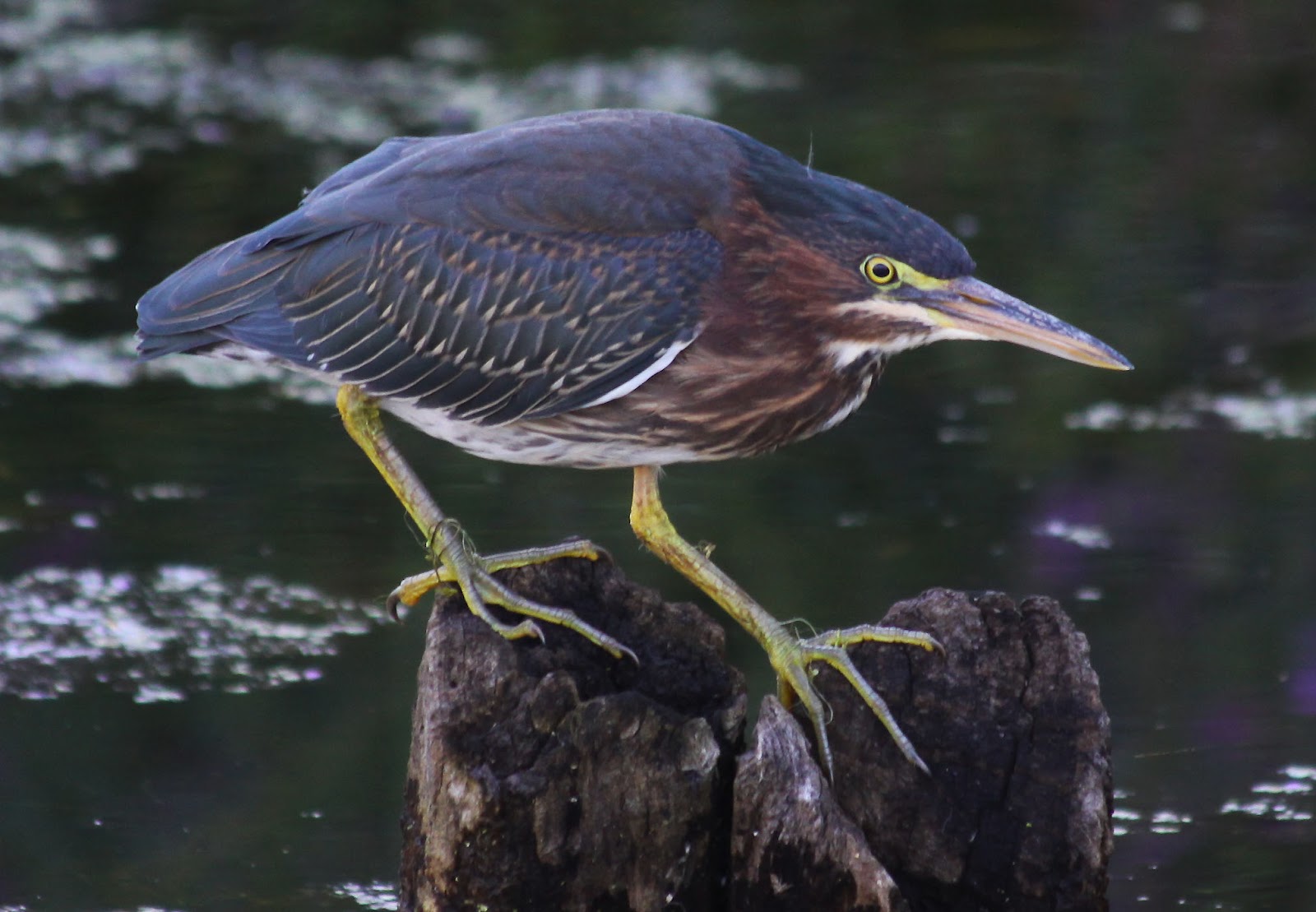
Green Heron Gathering
The Green Herons at Springbrook are getting ready to migrate already, which means they spend all their time out in the open on the edges of ponds looking for frogs or fish or anything else that moves.
I took these pictures this morning from Springbrook's long floating boardwalk. There were at least 25 of these herons hunting, preening, or noticing that a spot another heron had looked better, so let's fly over and check it out.
It seemed like they spent a lot of energy flying from one spot to another. There was almost always a couple of herons in the air checking out new locations.
In this picture their short stubby tail can be seen, and the crest on their head, which seems to be raised whenever something exciting/alarming enters the bird's mind.
In the picture below all the primary and secondary wing feathers can be seen and counted as the heron comes in for a landing. All the new feathers have molted in and it is ready to migrate.
Subscribe to:
Posts (Atom)